About Pomacanthus paru (Bloch, 1787)
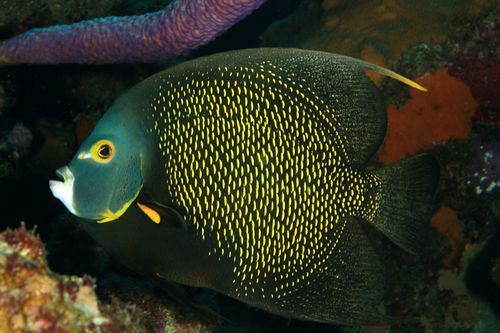
The French angelfish, scientifically named Pomacanthus paru (Bloch, 1787), has a deep, vertically compressed body that looks flattened when viewed from the front. It has a deep head with a short snout, which terminates in a small mouth holding many bristle-like teeth. A distinct spine is present at the corner of the preoperculum, while no spines grow on the operculum or beneath the eye. Its dorsal fin has 10 spines and 29 to 31 soft rays, and its anal fin has 3 spines and 22 to 24 soft rays. This species reaches a maximum total length of 41.1 centimetres (16.2 inches); males grow to around 18 inches (45 cm), and females reach a slightly smaller size. Both adult males and females have a black or dark gray body, which contrasts with the bright yellow tips on most of their body scales. They have a white mouth and a yellow orbit. The pectoral fins feature a wide orange-yellow band, and a long yellow filamentous extension grows from the soft-rayed section of the dorsal fin. Juvenile French angelfish have different coloration and markings than adults. Juveniles are almost entirely black except for five vertical yellow bands that span the full height of the body: the first sits around the mouth, and the last is at the caudal peduncle.
French angelfish are distributed in the western Atlantic, ranging from Florida through the Gulf of Mexico and the Caribbean (including the Antilles and Roatan) south to Brazil, and also occur in the eastern Atlantic around Ascension Island and St. Paul's Rocks. These fish are found at water depths greater than roughly 15 feet (4.5 meters), and have also been recorded in the mesophotic zone, which lies between 30 meters and 150 meters (roughly 100 feet to 500 feet) deep.
French angelfish do not show obvious courtship displays, and there is no clear sexual dimorphism between the sexes. Unlike its closest relative the grey angelfish, which mates in polygamous groups, this species forms monogamous pairs. Mating patterns of P. paru are not well studied, as mating behavior is rarely observed. From the limited observations, mated pairs swim up the water column, with one fish swimming directly behind the other. This reproductive behavior has only been reported to happen around sunset, or dusk. At dusk, the pair swims upward in a wide, shallow curve away from the substrate, traveling around 7 to 10 meters horizontally as they climb 2 or 3 meters (6 feet 7 inches or 9 feet 10 inches) in height. During their ascent, both fish angle their bodies slightly, holding their vents very close together – even touching. They maintain this posture through the zenith of their curve, then separate as they descend. Neighboring pairs have been observed performing similar movements above the reef at roughly the same time, but observers could not confirm whether gametes were released during these displays. Neighboring pairs do not interfere with each other's displays. This species is a protogynous hermaphrodite, meaning a female can change sex to become a male if no male is present.
Although French angelfish live in the same range as the closely related grey angelfish, the two species have never been observed producing hybrid offspring in the wild, nor forming mixed groups or pairs. In fact, grey angelfish may aggressively chase French angelfish. This behavior is hypothesized to stem from behavioral incompatibility: when members of the same species make agonistic approaches, grey angelfish respond by grouping with them, while French angelfish either continue aggressive behavior or flee. However, the viability of hybrid crosses between the two species has been confirmed in a laboratory setting. In 1976, researchers artificially extracted and mixed gametes to produce such hybrids. The study found that juvenile artificial hybrids could not be easily distinguished from juvenile grey angelfish, meaning if natural hybrids do occur, they would be difficult to identify at least in the juvenile stage.