About Pomacanthus navarchus (Cuvier, 1831)
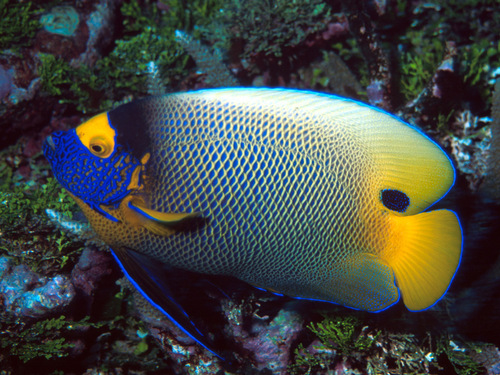
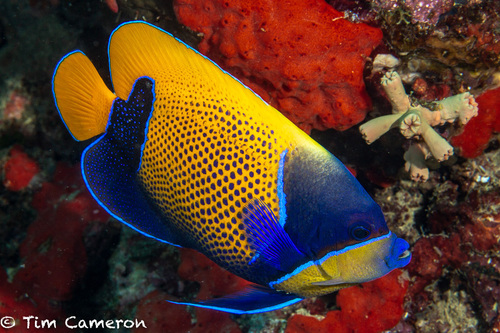
This fish species, Pomacanthus navarchus, has a laterally flattened body. Adults have three main distinct color sections: the anterior section in front of the eyes and the front part of the body is lemon yellow; the central funnel-shaped section is deep blue; and the posterior section has a bright yellow and blue reticulated pattern. These color sections are separated by pale blue bands edged with black. The mouth and lips are blue, and this blue color also applies to the rays of the pectoral and anal fins. The dorsal and caudal fins are yellow, edged with pale blue. A long defensive spine grows on the gill cover. Juveniles are dark blue with slightly curved white lateral stripes. The transition from juvenile to adult coloration happens quite abruptly, with very little intermediate coloration. Pomacanthus navarchus is native to the tropical Indo-Pacific region. Its range extends from Indonesia and the Philippines to northern and eastern Australia, the Great Barrier Reef, Micronesia, and Hawaii. It occurs at depths down to approximately 40 meters (130 feet), on outer reef slopes, in channels, and in lagoons that have coral-rich habitats. Pomacanthus navarchus is territorial and is most often found alone, though it may occasionally be seen in pairs or small groups. It lives in the demersal zone, and feeds on sponges, algae, tunicates, zooplankton, and small invertebrates. It is a protogynous hermaphrodite, meaning it starts its adult life as a female and later transitions to becoming a male.