About Pomacanthus maculosus (Forsskål, 1775)
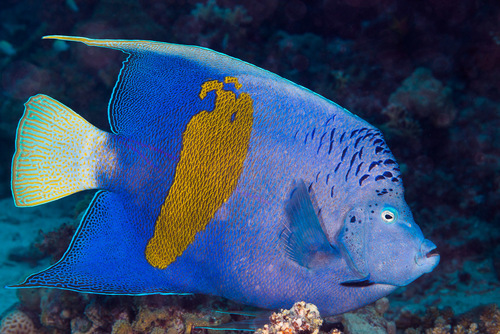
Pomacanthus maculosus (Forsskål, 1775) has a deep, compressed body with a small mouth that holds small bristle-like teeth. It has a clearly visible spine at the angle of the preoperculum. Adult individuals have filaments that extend backward from the soft-rayed sections of the dorsal and anal fins, and these filaments reach past the caudal fin. The adult body background color is brownish blue; each scale has a blue margin, giving the fish an overall predominantly blue appearance. An uneven yellow bar sits near the center of the fish’s flanks, with dark blue vertically elongated spots closer to the head. The caudal fin has wavy blue lines against a pale yellow background. Juvenile Pomacanthus maculosus are mostly black, marked with many curved vertical blue lines and three broader white lines. Only the rear third of the juvenile caudal fin is yellow. The dorsal fin of this species has 12–13 spines and 21 soft rays, while the anal fin has 3 spines and 19–20 soft rays. This species reaches a maximum total length of 50 cm (20 in).
This species is native to the Red Sea, Persian Gulf, and Gulf of Oman. Since 2008, it has been recorded on separate, uncommon occasions in the eastern Mediterranean Sea. It has also been recorded off the coasts of Florida and Brazil, a presence thought to result from deliberate releases from aquariums.
Pomacanthus maculosus occurs at depths between 4 and 50 metres (13 and 164 ft). It is a solitary species that lives in sheltered areas, often in locations with a mix of coral and silt. Its diet is dominated by sponges and tunicates, though it will opportunistically eat other invertebrates. Females reach sexual maturity at around 5.5 years of age, when they reach a total length of 21.6 cm (8.5 in). The maximum recorded longevity of this species is thought to be 36 years. Divers have observed that this species is curious and not shy. It is a protogynous hermaphrodite: when males are scarce, older females can change sex to become males. The larvae of this species are planktonic.