About Pomacanthus imperator (Bloch, 1787)
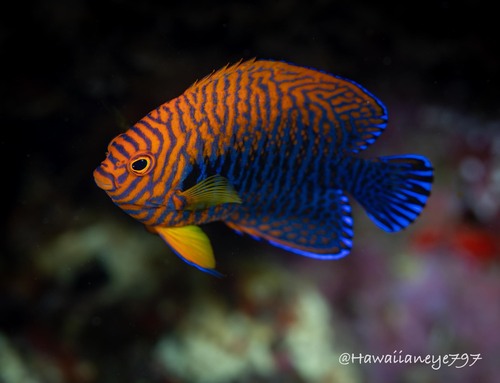
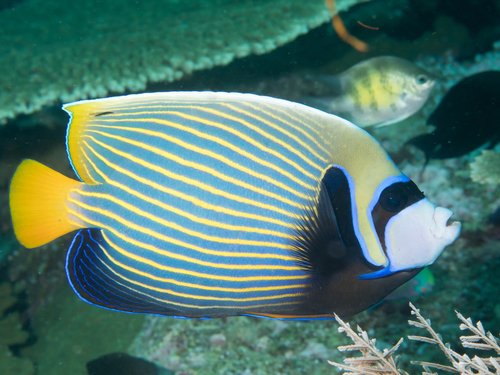
Emperor angelfish (Pomacanthus imperator) show a clear difference in appearance between juveniles and adults. Juveniles have a dark blue body marked with concentric curving lines that alternate between pale blue and white, with the smallest, fully enclosed lines located toward the back. These lines turn vertical at the front end of the body. Juveniles have a white margin on the dorsal fin and a transparent caudal fin. Adults have horizontal blue and yellow stripes across their body, a light blue face with a dark blue mask covering the eyes, and a yellow caudal fin. A blackish band sits above the pectoral fins, with its top edge level with the upper eye socket. The front edge of this band is bright blue, and its back edge is a thin yellow line. The anal fin has a dark blue base with lighter blue horizontal stripes. The dorsal fin has 13–14 spines and 17–21 soft rays, while the anal fin has 3 spines and 18–21 soft rays. This species reaches a maximum total length of 40 cm (16 in). Adults from Pacific Ocean populations have a filament trailing from the back of the dorsal fin, which is absent in Indian Ocean populations.
The emperor angelfish has a broad distribution across the Indo-Pacific. Its range extends from the Red Sea south along the East African coast to Mozambique and Madagascar, and east through the Indian and Pacific Oceans as far as the Tuamotu Islands and Line Islands. It reaches north to the Kansai region and southern regions of Japan, and south to Australia's Great Barrier Reef, New Caledonia, and the Austral Islands in French Polynesia. Vagrants have been recorded in Hawaii. The species has also been recorded at multiple sites off the coast of Florida and Puerto Rico, and since 2009 it has been a Lessepsian migrant in the eastern Mediterranean basin, where it now occurs in low numbers at multiple localities.
Emperor angelfish live at depths ranging from 1 to 100 metres (3.3 to 328.1 ft). Adults are found on clear lagoon, channel, or seaward reefs with abundant coral growth, where they are most often seen under ledges and inside caves. Subadults are commonly found in reef cavities and along surge channels on seaward reefs. Juveniles often take shelter under ledges, in reef cavities, and in relatively protected areas in channels and on outer reef flats.