About Pomacanthus arcuatus (Linnaeus, 1758)
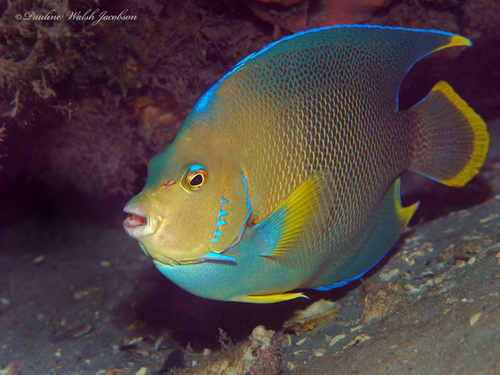
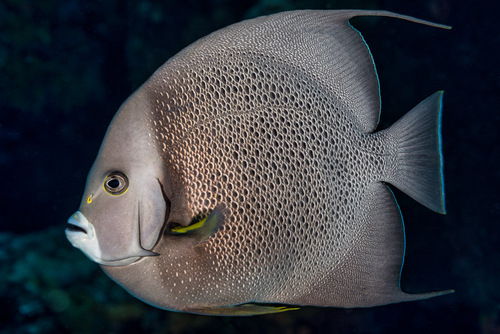
Pomacanthus arcuatus, commonly called the gray angelfish, has a disk-shaped, compressed body with a large head and small snout. A mouth sits at the tip of the snout, holding many small, bristle-like teeth. The preoperculum has a large spine at its corner and a smooth vertical edge. Juvenile gray angelfish have black bodies marked with five vertical yellow stripes: three on the head and two on the body. Their caudal fin has a black blotch that can be elongated or rectangular. Adult gray angelfish are pale gray and covered in black spots, with a plain pale gray head and a white mouth. The dorsal and anal fins often have elongated streamers. The dorsal fin has 9 spines and 31–33 soft rays, while the anal fin has 3 spines and 23–25 soft rays. This species reaches a maximum total length of 60 centimetres (24 in).
Gray angelfish are distributed in the Western Atlantic Ocean from New York to Rio de Janeiro, and they are typically not found north of Florida in winter. Their range covers the entire Caribbean Sea and the Gulf of Mexico, and they have been introduced to Bermuda from the Bahamas.
This species lives at depths between 3 and 30 metres (9.8 and 98.4 ft) over coral and rocky reefs. Juveniles are found in shallow depths on patch reefs and in seagrass beds.
In the northern parts of the gray angelfish's range, spawning takes place in summer, from April to September. Spawning has been recorded above deep reefs in early morning. Spawning fish swim one to two meters above the reef and engage in brief chases; the mating pair chases off any intruders. When ready to spawn, the pair swims upward, bringing their bellies together to release eggs and milt. Females can release between 25,000 and 75,000 eggs per spawning event, and the process may be repeated multiple times. The eggs are pelagic, and hatch into larvae after 15–20 hours. The larvae live among plankton until they grow to around 15 mm (0.59 in) in length, after which they descend to the reef and settle.
Eating gray angelfish is known to occasionally cause ciguatera poisoning, but the risk of ciguatera poisoning from consuming this species is considered low.