About Pomacanthus annularis (Bloch, 1787)
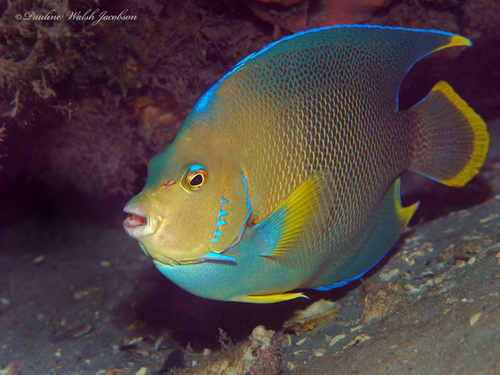
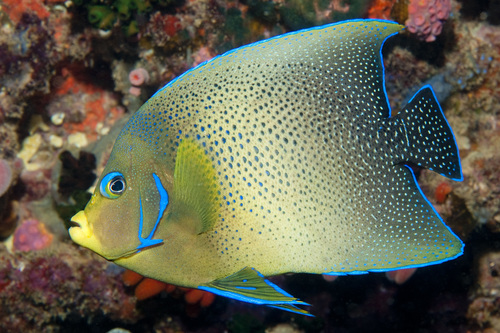
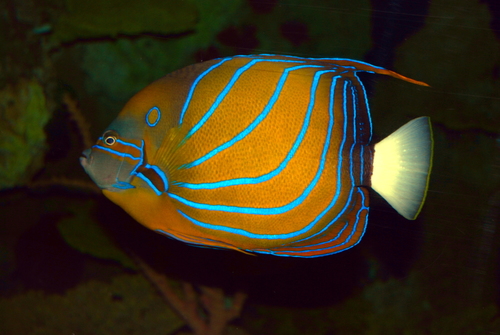
The bluering angelfish, scientific name Pomacanthus annularis (Bloch, 1787), shows clear physical differences between adults and juveniles. Adult bluering angelfish are mainly yellow, with obvious arcing blue lines on the body and a blue circular mark above the operculum. They often have an elongated tip on the dorsal fin, a white caudal fin with a yellow margin, and two blue stripes across the face: one runs through the eye, and the second sits right below the eye. Juveniles are overall bluish-black, with thin white to blue curved lines on their body. This species has 13 spines and 20–21 soft rays in the dorsal fin, and 3 spines and 20 soft rays in the anal fin. It reaches a maximum total length of 45 cm (18 in). The bluering angelfish occurs in the Indo-West Pacific, ranging from East Africa through Indonesia and New Guinea to New Caledonia, and north to southern Japan. It inhabits coastal rocky coral reefs, and can also be found in caves or on wrecks, at depths of 3–30 m (9.8–98.4 ft).