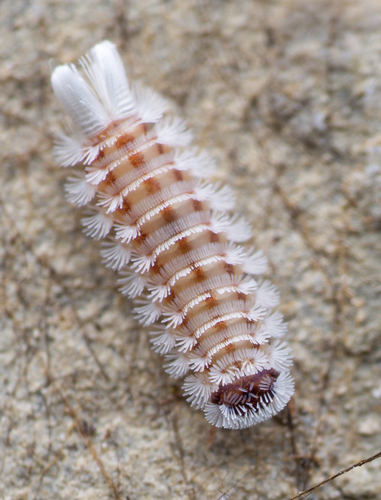
About Polyxenus lagurus (Linnaeus, 1758)
This small millipede species, Polyxenus lagurus, ranges from 2 mm to 4 mm in length and 0.5 mm to 1.0 mm in width. Adult individuals have ten tergites and 13 pairs of legs. Their bodies are flat, pale brown, and covered with brown bristles. These bristles are arranged in two transverse rows, with lateral tufts on every segment including the head and collum. Lateral tufts are also present on every pleurite except the first, and two long bristle brushes sit at the posterior end of the telson. The species' genital openings are located behind the second pair of legs. In sexually reproducing populations, females are slightly larger than males.
Polyxenus lagurus is distributed across the Holarctic realm, with widespread populations in Europe and North America. It is the most common species in the order Polyxenida in Europe, and the only known member of this order in the British Isles. In North America, it has been recorded in the U.S. states of Massachusetts, New York, New Jersey, Ohio, Michigan, Illinois, Colorado, Montana, Arizona, and Washington, and in the Canadian provinces of Nova Scotia, Québec, Ontario, and British Columbia. It is also found in Melbourne, Australia, where it is suspected to have been introduced by humans.
This millipede is most frequently found under the bark of dead trees, particularly coniferous dead trees. It also occurs in forest leaf litter and under stones. In coastal regions, it can be found at the roots of halophile plants, and on lichens and moss growing on boulders. While it typically occupies litter and bark, it is also commonly found on rocks and old stone or brick walls. It is easiest to locate at night, especially in humid conditions, but it is also active during the day, often in warm, dry conditions and direct sunlight. It is thought to feed on lichens, algae, and small fungi.
In sexually reproducing populations of this species, males transfer sperm to females indirectly rather than directly. Males build a silken web, place a spermatophore on the web, then create signal threads to guide females to the spermatophore. Males produce these threads from glands that open at the base of their eighth and ninth leg pairs. Females follow the threads to the spermatophore and press their genital opening against it to receive sperm. After mating, females lay fewer than twelve eggs, glue the eggs in place with a sticky secretion, and protect the eggs with a mass of bristles taken from the bristle brush at the end of their telson.
Other populations of this species reproduce parthenogenetically, with no males present. In Europe, the proportion of males in populations decreases from southern France through the Netherlands, Denmark, and Sweden, to Finland where males may be completely absent. Parthenogenetic populations are found in Germany, Poland, and Russia. Sexually reproducing populations tend to prefer humid coastal habitats, and occur in southern France, the Netherlands, and the British Isles. Both reproductive forms are found in southern Scandinavia.

