About Polyura eudamippus (Doubleday, 1843)
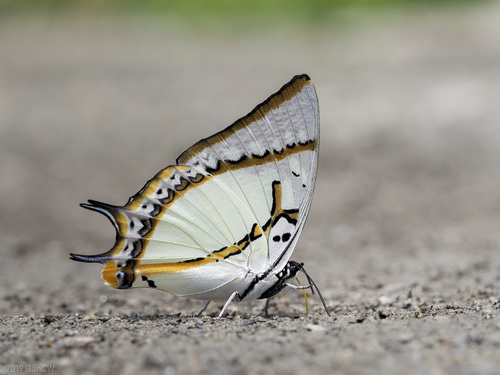
Polyura eudamippus (Doubleday, 1843) has the following morphological description. The upperside ground colour is pale yellowish white. On the forewing, the costal margin, the anterior part of the cell, a transverse bar at the cell apex, which joins a broad line at the base of interspace 3, and the entire apical half of the wing are purplish black. This black area narrows toward the posterior, extends to the tornus, and holds the following yellowish-white spots: one spot beyond the apex of the cell, followed by two obliquely placed spots beyond that, plus an oblique postdiscal series and an erect subterminal series of spots. On the hindwing, there is a postdiscal black band that narrows posteriorly; its inner margin is slightly sinuous, while its outer margin is highly sinuous. This band is traversed by an inner series of blue lunules and an outer series of prominent yellowish-white spots. Following the band are a narrow subterminal blue band and a terminal black line, both of which end before reaching the tornus. The tornus, which lies beyond the end of the postdiscal black band, is conspicuously yellowish white. The underside is silvery white. On the forewing, there are two black spots in the cell, followed by a short isolated Y-shaped mark, an oblique discal band and an erect terminal band that are olivaceous brown. The Y-shaped mark has its fork at the lower apex of the cell, is more or less bordered on both sides by conspicuous broken black lines, and does not extend to either the costa or below vein 2. The discal band is outwardly margined by a series of detached black lunules. The hindwing has three transverse brownish-yellow bands: an excurved baso-median band, bordered anteriorly on both sides by broken black lines, that meets a postdiscal band above the tornus. The postdiscal band is outwardly bordered by a series of black lunules with whitish centres, and there is a detached row of black spots in the interspaces. There is also an irregular subterminal band that is outwardly bordered with greenish. The tails are black with a median pale blue streak; the tornus is conspicuously ochraceous; a short subtornal transverse black line runs from the dorsum to the baso-median band. Antennae and head are black, the thorax is dusky greyish black, and the abdomen is yellowish white. On the underside, the palpi, thorax and abdomen are white, with a conspicuous obliquely transverse black line on each side of the thorax. The wingspan of this species ranges from 98 to 121 millimetres (3.9 to 4.8 inches). This species is distributed in north-eastern India (Sikkim, Assam), Nepal, Bhutan, Burma, China, Taiwan, Malaysia, and Indochina.