About Polyura athamas (Drury, 1773)
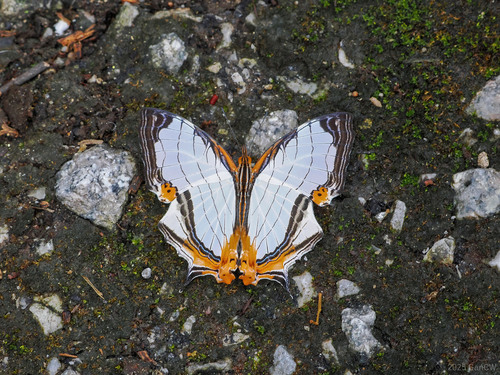
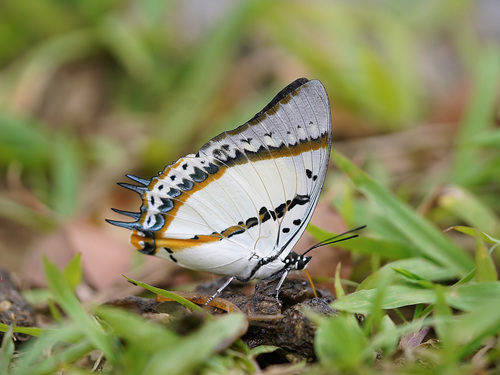
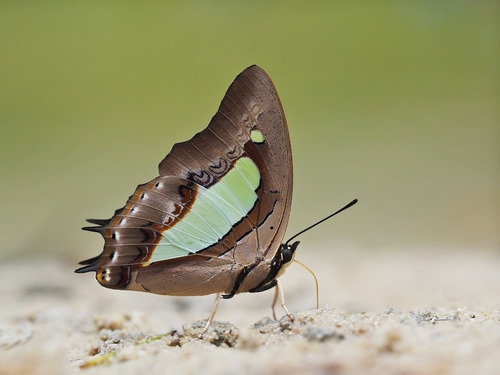
This species, Polyura athamas (Drury, 1773), shows consistent patterns across both males and females. On the upperside of the wings, the base color is black. A broad pale yellow transverse discal area extends from below vein 4 on the forewing to vein 2 on the hindwing. Additional pale yellow markings include a moderately large spot in forewing interspace 5, a tiny preapical dot in forewing interspace 6 beyond this spot, and a subterminal row of spots on the hindwing with two or three extra spots at the hindwing tornal angle. The pale yellow markings sometimes have an ochraceous or greenish tinge. On the forewing, the discal area is nearly the same width in interspace 3 as it is along the dorsum; on the hindwing, this area narrows to an acute point on vein 2, two-thirds of the way from the wing base to the wing tip. The species' tails are marked with bluish grey. On the underside of the wings, the discal transverse area and the interspace 5 spot match the markings seen on the upperside. The base and costal margin of the forewing (extending to the apex), as well as the base and broad dorsal margin of the hindwing, are colored lilacine brown; the forewing also has two small black spots near its base. A broad carved chocolate band borders the inner side of the transverse discal area alongside black lines, and continues above the area; this band runs more narrowly along the outer side of the discal area. Beyond this band on the forewing sits a concave series of dusky black lunules, while on the hindwing, the chocolate band is crossed by a line of faint pale lunules. At the hindwing, there is a final subterminal series of black spots each bordered with white on the inner side, followed by a faint ochraceous terminal line; above the tornal angle, a slender transverse black line runs from vein 1 to the dorsal margin. The wingspan of this species ranges from 64 to 85 mm. In terms of ecology, female butterflies lay their eggs on a wide variety of Fabaceae plant species. Known host plants include multiple acacia species: A. caesia, A. catechu (black cutch), and A. farnesiana (needle bush), as well as Adenanthera pavonina, several Albizia species (A. chinensis, A. corniculata, A. julibrissin (nemu tree), and A. lebbeck (siris or lebbeck)), multiple Caesalpinia species (C. bonduc, C. major, and C. regia), Delonix regia (gulmohar), Grewia species, Leucaena leucocephala (white popinac), Peltophorum pterocarpum (copperpod), Pithecellobium clypearia, and Pithecellobium dulce (monkeypod). At least in Borneo, and most likely in other regions as well, adult butterflies generally do not visit carrion or old fruit to feed on liquids.