About Polytrichum strictum Menzies ex Brid.
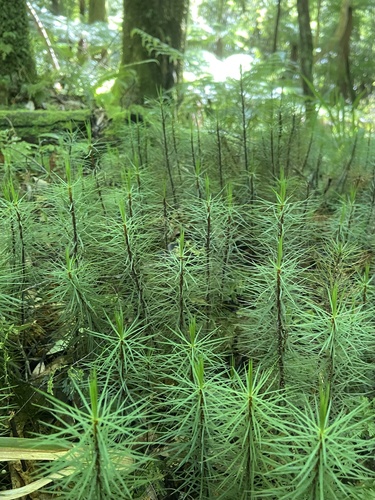
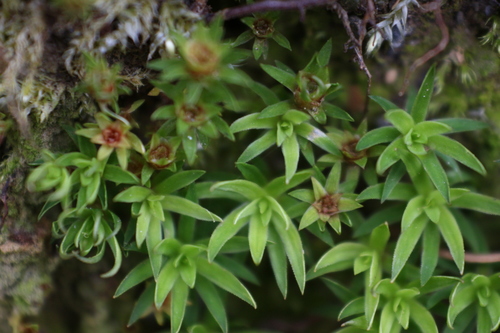
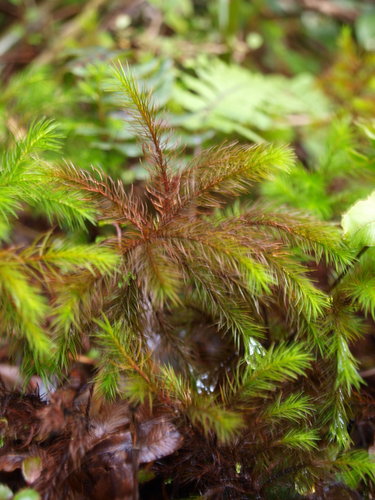
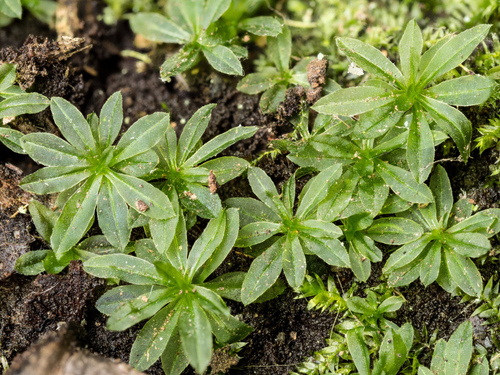
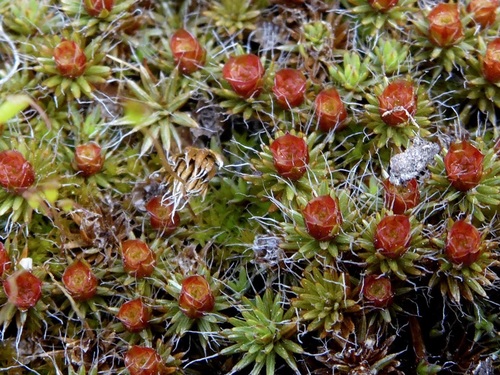
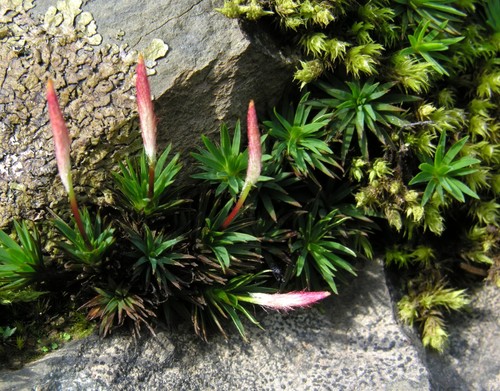
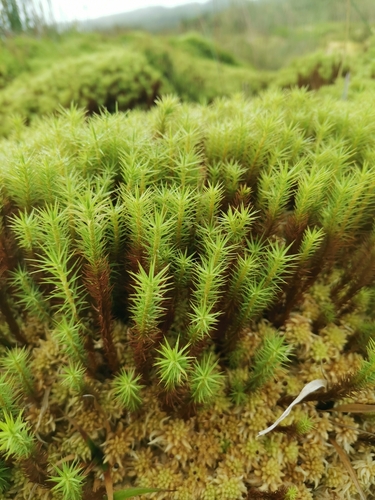
Like other members of the Polytrichaceae family, Polytrichum strictum Menzies ex Brid. has leaves with a single costa, vertical lamellae, a water-repelling cuticle, and rhizoids. These rhizoids anchor the plant and also appear to help facilitate external water movement. This moss forms dense tufts of slender stems that are 6–12 cm tall, and these tufts build up into 20–40 cm hummocks in bogs and similar substrates. Its leaves are narrowly lanceolate, lying pressed against the stem when dry and spreading to an erect position when moist. A reddish awn (formed by the slightly excurrent costa) and smooth, inrolled leaf margins separate P. strictum from most other Polytrichum species; only juniper haircap moss (P. juniperinum) shares these features. However, P. strictum can be easily distinguished from P. juniperinum by its wooly-tomentose white rhizoids that extend up its stems, which are absent in P. juniperinum, as well as by its preference for boggy habitats and organic soils, while P. juniperinum is weedy and prefers mineral soils. Polytrichum strictum is distributed throughout Canada, the northern half of the United States, Greenland, Iceland, the Faroe Islands, northern Europe and Asia, Antarctica, and the southern half of South America. It is a characteristic species of boggy peatland habitats dominated by Sphagnum mosses, but it can also grow in wet heaths, tundra, sedge meadows, and peaty forests from low to high elevations; in warmer climates, it is largely restricted to relict bogs. It grows on the top of peat hummocks, and often contributes to forming these hummocks. Polytrichum strictum is dioicous: male and female gametophytes (the haploid (1n) life stage) produce male and female reproductive structures separately. Just as in other Polytrichum species, antheridia (the male reproductive structures) grow at the tips of male plants. When mature, the antheridia swell and burst to launch sperm into the air; they also develop in splash cups, which further help sperm dispersal by capturing and using the energy of raindrops. Sperm that reach near the archegonia (female reproductive structures, also borne at the tips of female plants) use their two whiplash flagella to swim down the archegonial neck into the venter, where one sperm will fertilize the ovum. After fertilization, the resulting zygote develops into the diploid (2n) sporophyte, which is made up of a foot embedded in gametophyte tissue, a stalk called a seta, and a capsule. The capsule is covered by a dirty-white calyptra, and matures after the seta elongates, at which point the calyptra falls off. Inside the capsule, each sporocyte undergoes meiosis to produce four haploid (1n) spores. When spores are mature, the operculum is expelled and spores are released through the peristome, which is connected to an epiphragm and ringed by 64 nematodontous teeth. When conditions and substrate are suitable, spores germinate into a filamentous protonema, and gametophytes grow from the protonema, completing the life cycle. In ecological restoration, Polytrichum strictum is considered an important pioneer species in peatlands, and can tolerate a wide range of environmental conditions and disturbance regimes. It plays a key role in preventing frost heaving in harvested peatlands, and research indicates it can be used for restoring unstable peat areas. However, little is currently known about whether it helps or hinders the growth of Sphagnum mosses.