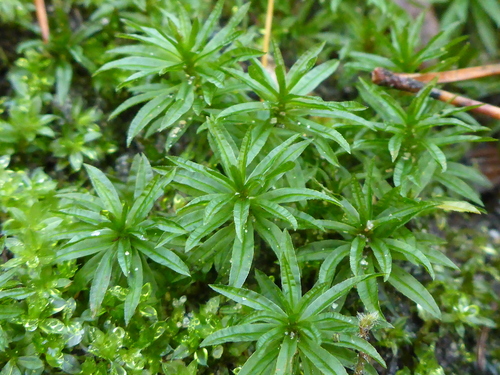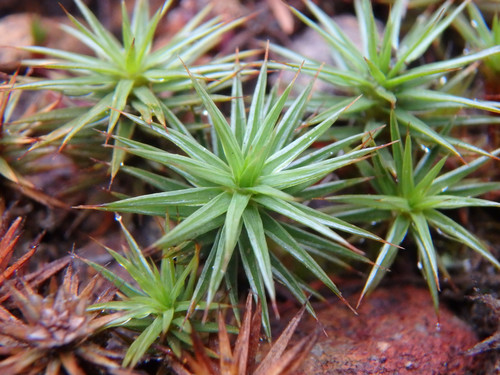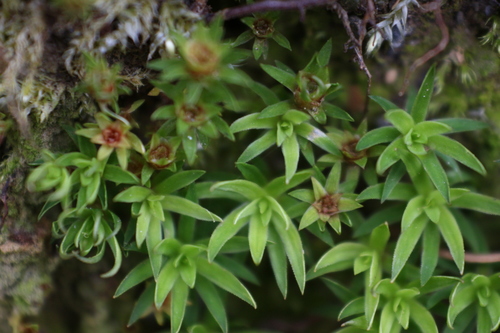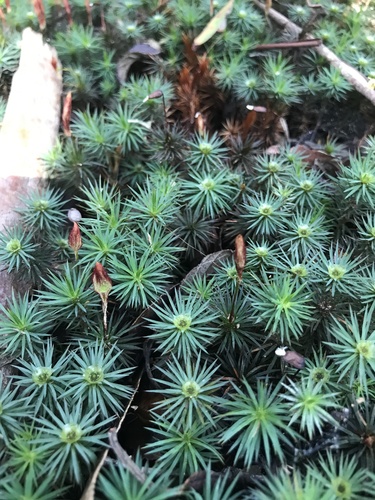
About Polytrichum piliferum Hedw.
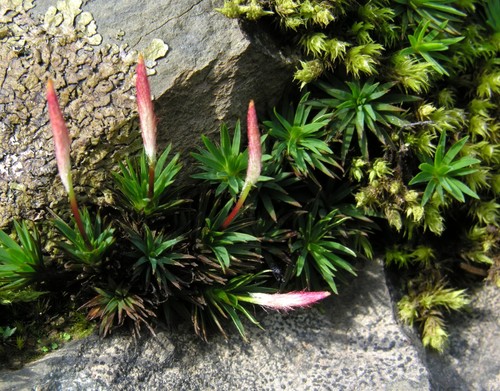
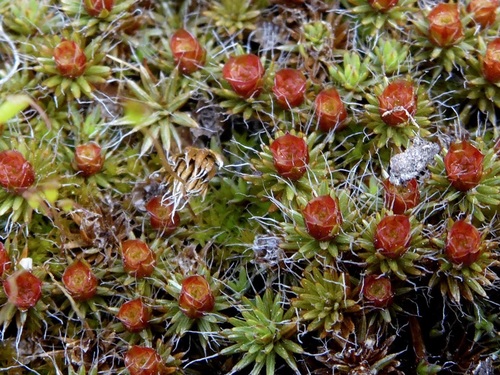
Sporophytic characteristics: The sporophytes of Polytrichum piliferum are common, and typically reach maturity in summer. The sporangia are cube-shaped and inclined, becoming more horizontal once they mature. They grow on red-brown seta that measure roughly 1 cm to 3 cm tall. Distribution: Polytrichum piliferum has a bipolar, cosmopolitan distribution, growing in suitable habitats across all continents, including Antarctica. It is less common than Polytrichum juniperinum, and often grows alongside Cladonia species. In sandy dry grasslands, this species prevents higher plants from growing. Habitat: It occurs in habitats similar to those of Polytrichum juniperinum, but Polytrichum piliferum prefers more open, exposed locations. It also favors drier environments, and can tolerate temperatures between 90°C and 100°C. It is frequently found in acidic, low-nutrient areas, so it can act as an excellent indicator of nutrient levels. Habitats for Polytrichum piliferum include shallow soil over rock outcrops, exposed sandy bank soils, gravel cover, and disturbed areas. Additional habitats include rocks on road banks or pastures. It also grows in shallow, drained sand or gravel, such as ground covering rocks and boulders. Reproduction: Polytrichum piliferum is dioicous, meaning individual plants are either male or female. For sexual reproduction, this moss uses the splash-cup mechanism to disperse sperm produced by its antheridia. In the splash-cup mechanism, raindrops splash onto the antheridia, pick up sperm, and are splashed onto female plants, where the sperm can then swim to the archegonia.