About Polytrichum juniperinum Hedw.
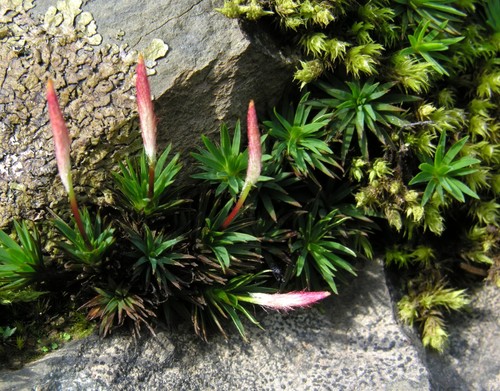
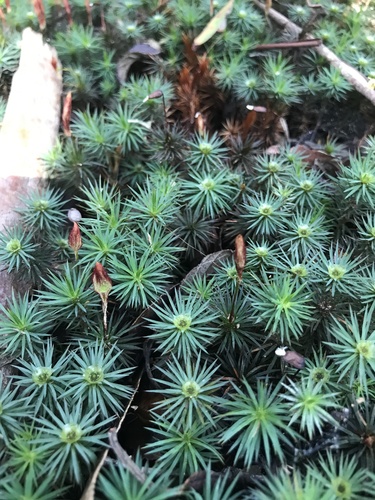
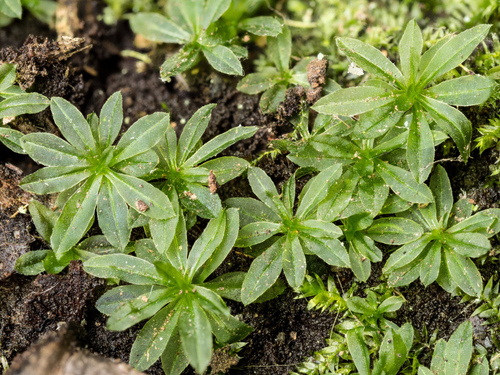
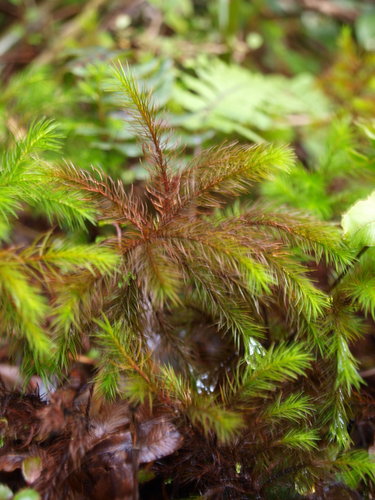
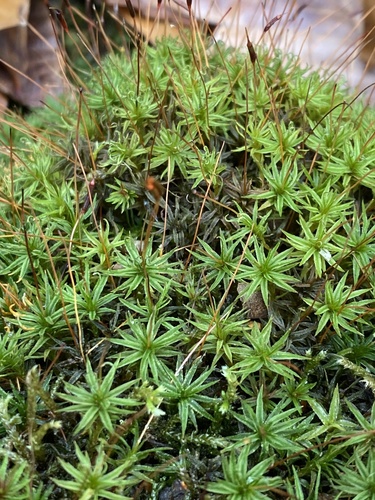
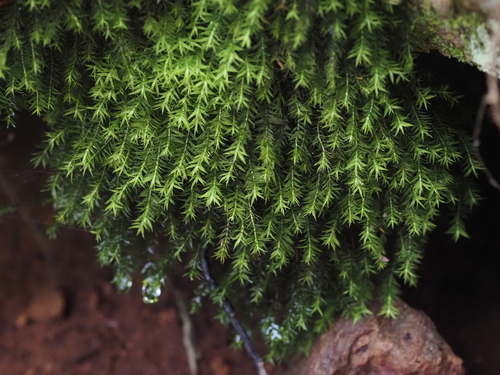
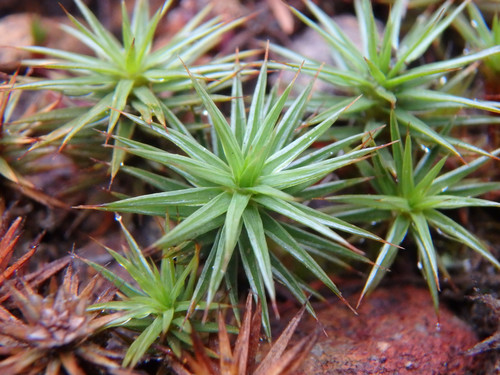
Polytrichum juniperinum Hedw., commonly called juniper haircap moss, has reddish stems with grey-green leaves that bear a distinctive red-brown tip. This trait separates it from the closely similar bristly haircap (Polytrichum piliferum), which has a clear white leaf tip instead. The leaves of this moss are lanceolate: they are upright-spreading when dry, and wide-spreading when moist. While growth form can vary, juniper haircap moss generally forms thin, interwoven mats rather than growing as closely grouped individual plants. This species has a well-developed system of tiny tubes that carry water from its rhizoids to its leaves, a feature uncharacteristic of most mosses that instead resembles the water transport system evolved in vascular plants like ferns, gymnosperms, and angiosperms. Because of this developed transport system, its stems can grow taller than stems of typical moss species. Juniper haircap moss grows across a wide range of habitats, and is most commonly found in dry, acidic, exposed locations. It occurs frequently in areas previously disturbed by fire and logging. Other habitats it occupies include mineral soil, humus, rocks, stumps, banks, trailsides, and dry open woods. While it is not usually found in moist or wet environments, it has also been recorded growing in moist woods and other moist sites such as streambanks. In Britain, it is common in upland grassland such as the U1 Festuca ovina community, as well as in acid woodlands, especially W16 Quercus petraea woods, and it also grows in various types of heathland. This species is dioecious, meaning male and female gametophytes grow on separate individual plants. Male and female reproductive structures are very obvious. Male plants are unusual because they continue growing without shedding their old male organs. Male plants are highly noticeable due to their bright reddish-orange modified leaves, which form small terminal 'flowers' at the ends of shoots. Like other mosses, juniper haircap moss has a gametophyte dominant life cycle. Water is required for reproduction, to allow sperm to swim down the neck of the archegonia to reach the egg. After fertilization, the sporophyte of juniper haircap moss grows from the female gametophyte, emerging from the archegonia. The sporophyte is made up of a foot that anchors it to the archegonia, a stalk, and a spore capsule. There are 64 short blunt teeth surrounding the mouth of the capsule at its top. The capsule's hood, called the calyptra, has long hairs that extend down the entire length of the capsule, which gives the group its common name 'haircap moss'.