About Polytrichum commune Hedw.
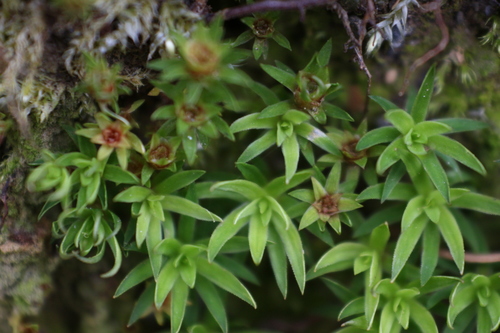
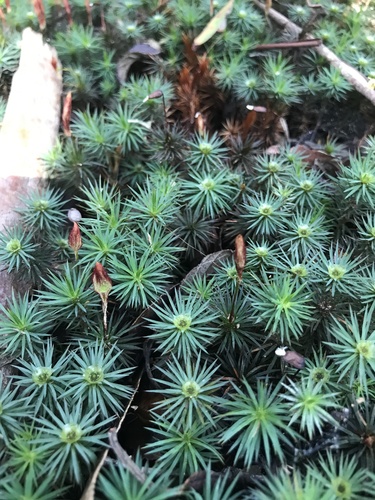
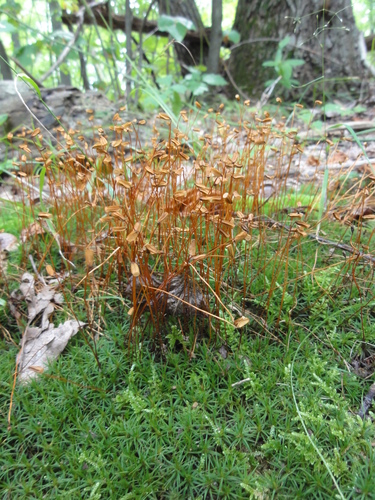
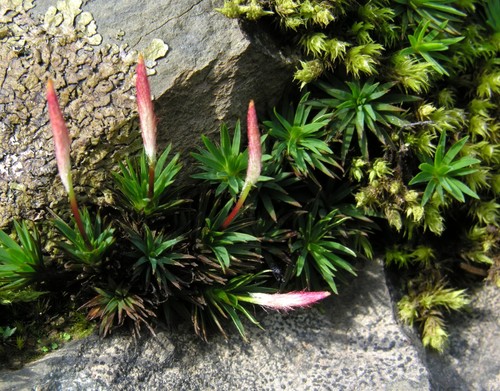
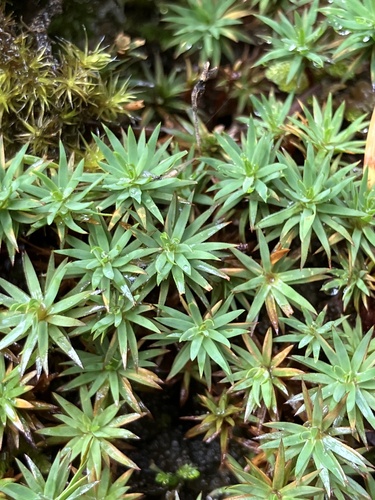
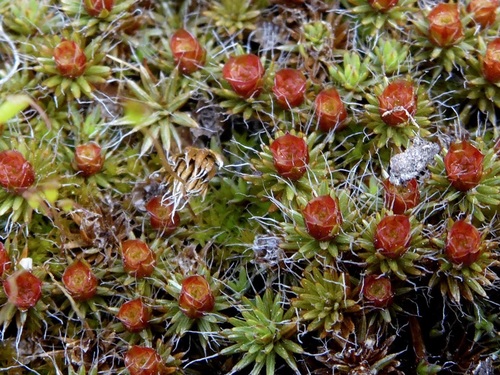
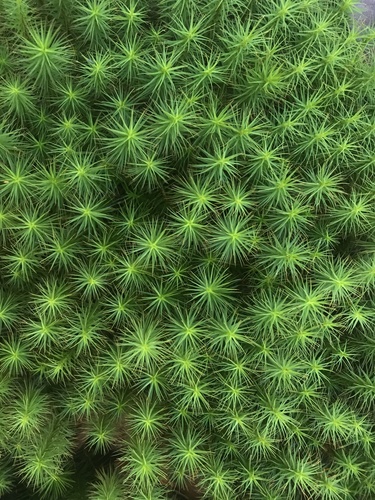
Polytrichum commune Hedw. is a medium to large moss. It is dark green when young, turning brownish as it ages. Its stems grow in either loose or quite dense tufts, and often form large extensive colonies. Stems most commonly reach 5 to 10 cm (2.0 to 3.9 in) in length, but can be as short as 2 cm (0.79 in) or as long as 70 cm (28 in). Stems range from erect to decumbent (reclining) in stiffness, and are usually unbranched, though they may rarely be forked. Leaves grow from densely to rather distantly arranged along stems, with bracts present near the base of the stems. Leaves typically measure 6 to 8 mm (0.24 to 0.31 in) in length, but can reach up to 12 mm (0.47 in) long. When dry, leaves are erect; when moist, they are sinuous with recurved tips, and are generally spreading to broadly recurved, or sharply recurved from the base. The leaf sheath is oblong to elliptic in outline, forms an involute tube (with inward rolling margins) that clasps the stem. This sheath is typically golden yellow and shiny, and it narrows abruptly to a narrowly lanceolate leaf blade. When viewed under a microscope, the marginal lamina is level or erect, narrow, and typically 2 to 3 cells wide, though it may sometimes be as many as 7 cells wide. It bears teeth from the base of the blade up to the apex; the teeth are unicellular and embedded within the margin. The costa, the central stalk of the leaf, has teeth on its underside near the apex, and is excurrent, meaning it extends beyond the tip of the leaf apex, ending in a short, rough awn. Lamellae, ridges of cells that run along the leaf surface, are crenulate (marked with small rounded teeth) in profile and 5 to 9 cells high. Their margins are distinctly grooved with 2 rows of paired, projecting knobs. When observed in cross section, the marginal cells may be narrow, but are more typically enlarged and wider than the cells that lie beneath them. Marginal cells range from retuse (having a rounded apex with a central shallow notch) to deeply notched, and in rare cases are divided by a vertical partition. These cells are smooth, brownish in colour, and have relatively thick cell walls. Sheath cells measure 60 to 90 μm (0.0024 to 0.0035 in) long by 10 to 13 μm (0.00039 to 0.00051 in) wide. They may be elongated rectangles or strongly linear structures up to 20 times as long as they are wide, and become narrower toward the sheath margins. Marginal lamina cells are 10 to 15 μm (0.00039 to 0.00059 in) wide and subquadrate (nearly square). This moss species is sexually dioicous. Fertilization happens when raindrops splash sperm from male splash-cups onto female plants that carry eggs. The fertilized egg develops into a sporophyte, which holds a spore capsule high atop a stalk. The leaves of the perichaetium have a long sheath with a scarious (membranous) margin, while their blades are greatly reduced, gradually narrowing to a finely acuminate tip. These blades have toothed margins, range from denticulate to subentire in outline, from roughened to almost smooth in texture, and have an excurrent costa. The seta, or capsule stalk, is 5 to 9 cm (2.0 to 3.5 in) long, stout, and yellowish to reddish brown in colour. The spore capsule is 3 to 6 mm (0.12 to 0.24 in) long, slightly rectangular to cubic in shape, and brown to dark reddish brown in colour. It has four sharp wings, is oriented from inclined to horizontal, and is glaucous when fresh. The peristome measures 250 μm, is pale in colour, and has 64 teeth. The peristome of this haircap moss is specifically nematodontous, meaning it is made of multiple layers of intact cells. The calyptra is golden yellow to brownish and completely envelops the capsule. Spores measure 5 to 8 μm (0.00020 to 0.00031 in), but may reach up to 12 μm (0.00047 in).