About Polytmus theresiae (Da Silva Maia, 1843)
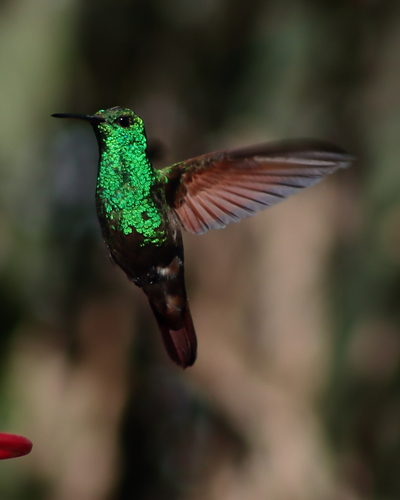
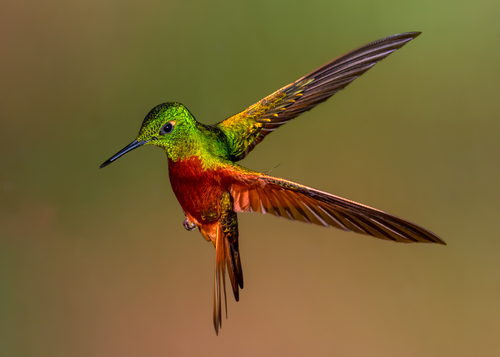
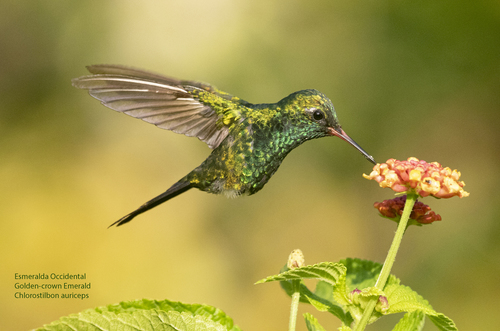
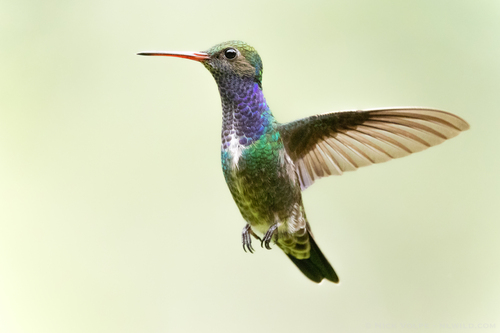
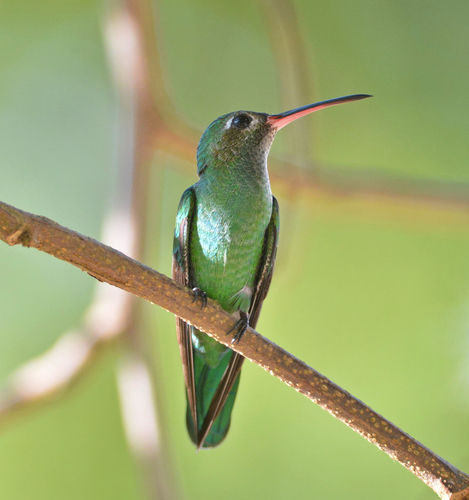
The green-tailed goldenthroat (Polytmus theresiae) measures 8.9 to 9.9 cm (3.5 to 3.9 in) in length and weighs 3.0 to 3.9 g (0.11 to 0.14 oz). Both sexes of both recognized subspecies have a long, slightly decurved bill that is pinkish and black. For the nominate subspecies, the adult male has overall shining green plumage. Its rounded tail is green, and all feather pairs except the central two have white at their base. The area surrounding the eye is dusky gray, with a distinct white spot behind the eye. The adult female is smaller than the male; its throat and breast are whitish, thickly covered with green spots, and the outermost tail feathers have white tips. Juveniles resemble adult females, but have buffy edges on the feathers of the head. Subspecies P. t. leucorrhous is essentially identical to the nominate subspecies, except that it has a white vent area and white undertail coverts. The nominate subspecies of green-tailed goldenthroat occurs in the Guianas and north-central Brazil, ranging from the lower Negro and Madeira rivers eastward into the states of Pará and Amapá. P. t. leucorrhous is found from eastern Colombia and southern Venezuela into the upper Negro River region of Brazil, with a separate population in eastern Peru and northern Bolivia. The South American Classification Committee (SACC) of the American Ornithological Society additionally lists the species as hypothetical in Ecuador. This species inhabits the edges of sand-soil forest and sandy savanna that has scattered small trees and thicket stands. It generally occurs at elevations between 100 and 300 m (330 and 980 ft).