About Polystictus superciliaris (Wied-Neuwied, 1831)
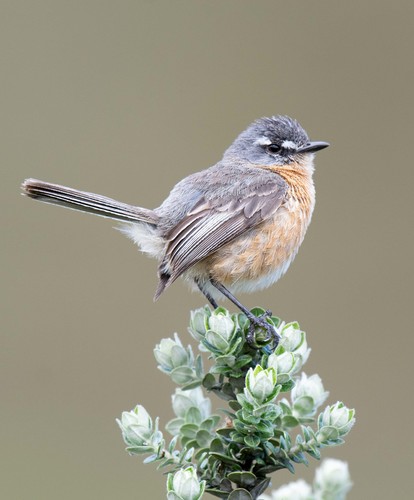
The grey-backed tachuri, scientifically named Polystictus superciliaris (Wied-Neuwied, 1831), measures 9.5 to 10 cm (3.7 to 3.9 in) in length and weighs approximately 6 grams (0.21 oz). Males and females share identical plumage. Adult individuals have a gray crown with a short crest; the white center of the crown is mostly concealed. They feature a short white supercilium, a white eye ring, and a thin blackish line that runs through the eye, with the rest of the face having thin black and white stripes. Their upperparts are brownish gray. Their wings are dark dusky brown, with slightly paler brown edges on the flight feathers and paler tips on the wing coverts; these pale tips form two distinct wing bars. Their tail is dusky. Their chin is whitish, while their throat and underparts are mostly pinkish buff, fading to white on the lower belly. Juveniles have a cream-colored belly. Both sexes have a dark brown iris, a black bill, and black legs and feet. The grey-backed tachuri has a disjunct range across eastern Brazil. One population lives in central Bahia, and a second population extends from northern Minas Gerais south into northern Paraná. The species is also found locally in scattered locations north and west of these two main population areas. It primarily lives in campos rupestres, a rocky grassland biome with scattered shrubs. It also occurs in overgrown brushy abandoned pastures, and at higher elevations, it can be found in grasslands and the brushy edges of cloudforest. Its elevation range is from 900 to 2,300 m (3,000 to 7,500 ft), though most individuals are found below 1,700 m (5,600 ft).