About Polystichum acrostichoides (Michx.) Schott
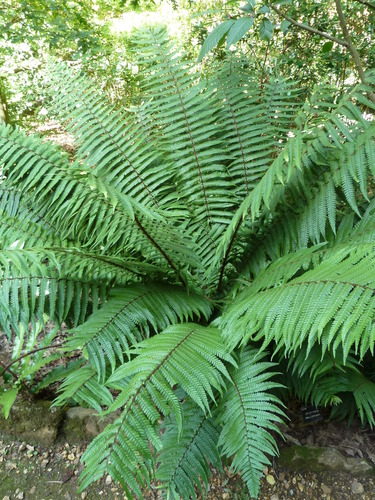
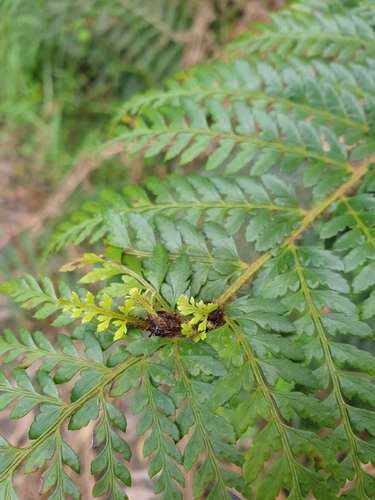
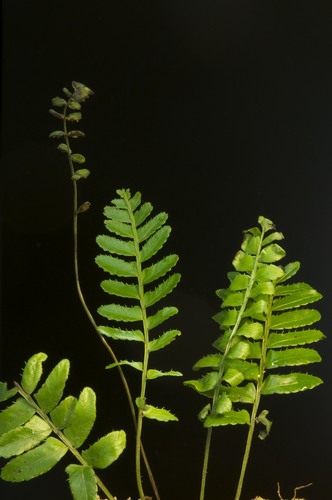
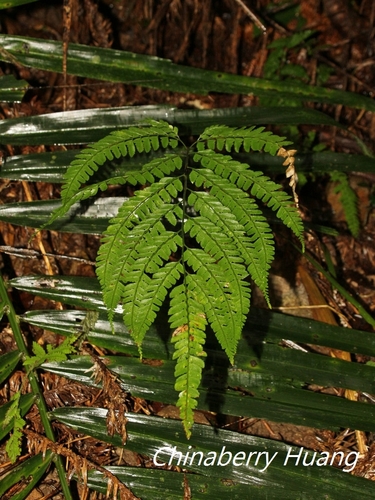
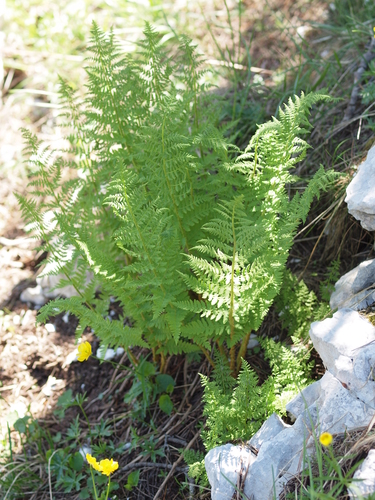
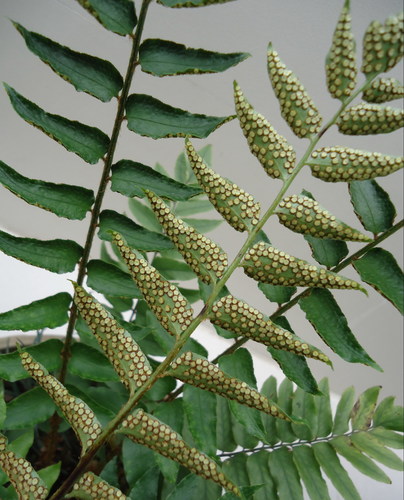
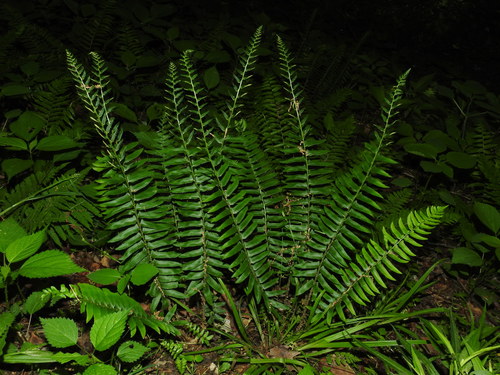
Christmas fern (Polystichum acrostichoides) has a tufted, clumping growth habit, with all fronds growing from a single central point. It can form colonies, but it often grows alone, or in groups of just two or three individuals. As an evergreen species, this fern retains its sterile fronds through winter, while its fertile fronds die off each winter. Low temperatures and the presence of snow trigger tropism cues that cause overwintering sterile fronds to reorient toward the ground, an adaptation that helps preserve the fronds. Each frond is supported by a stipe (frond stem) that ranges from dark brown to black, and makes up one quarter to one third of the frond's total length. The stipe is covered in coarse, translucent, light brown to tan scales that are typically around 5 millimetres (0.20 in) long. In early spring, the coiled developing fronds called crosiers are prominent; they are scaly and greyish in color. Mature fronds are 30 to 80 centimetres (12 to 31 in) long, 5 to 12 centimetres (2.0 to 4.7 in) broad, dark green, and have a rather leathery texture. Very sparse hairs may cover the undersides of fronds. Each frond holds 20 to 35 pairs of pinnae. Individual pinnae are typically 4 centimetres (1.6 in) long, shaped oblong to falcate, and have finely serrulate or spiny edges. The small teeth or spines along the pinna edge all point toward the tip of the pinna. Each pinna has a small, triangular, thumblike lobe at its base. Light brown spores are produced on fertile pinnae located at the tip of the frond; these fertile pinnae are noticeably smaller than the sterile pinnae found lower on the same frond. Fertile pinnae are classified as "acrostichoid" because sporangia cover most of the lower surface of the pinna. Christmas fern resembles the Pacific Coast sword fern Polystichum munitum, but it forms less expansive tufts. It differs from P. munitum and almost all other ferns by having noticeably smaller fertile pinnae that grow on the same frond as larger sterile pinnae. Polystichum acrostichoides is known to hybridize with Polystichum braunii in regions where the two species have overlapping ranges. In ecology, the fungus Taphrina polystichi parasitizes Polystichum acrostichoides, causing yellowish to whitish galls to form on the fern's fronds. Larvae of the moth Herpetogramma sphingealis feed on Christmas fern; this moth species occurs primarily in areas where Christmas fern is abundant, and was first formally scientifically described in 2011. In cultivation, Christmas fern is a popular ornamental plant for gardens, including natural style gardens, because it is easy to grow across a wide range of environments and soil types. Since it is evergreen, it is sometimes used in garden designs focused on winter interest. This fern can help conserve soil and reduce erosion on steep slopes. Its fronds stay semi-erect until the first killing frost, after which they lie flat prostrate on the ground. In this position, they effectively hold the forest floor duff layer in place, allowing the duff to decompose gradually into humus, which builds up soil over time.