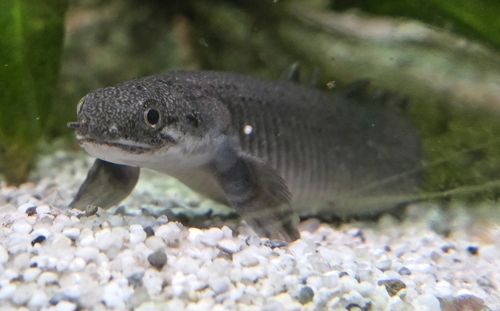
About Polypterus senegalus Cuvier, 1829
Polypterus senegalus, commonly known as the Senegal bichir, gray bichir, or Cuvier's bichir, is an African species of ray-finned fish that belongs to the bichir family Polypteridae. It is a typical example of polypterid fish, as most of its defining physical features are shared across the entire Polypterus genus. These features include its ancient appearance, which resembles lungfish or arowana, its ability to breathe atmospheric oxygen, and its armor-like scales. These traits have made the species popular in captivity, and it is commonly kept by aquarists and other hobbyists. P. senegalus is sometimes confusingly given misnomers like "dinosaur eel" or "dragon fish", but bichirs are not eels, nor are they reptiles or dinosaurs. This species of bichir lives in lakes, river margins, swamps, and floodplains across tropical Africa and the Nile river system, and it occurs in at least twenty-six African countries including Senegal, Egypt, the Democratic Republic of Congo, Cameroon, Chad, Ethiopia, Kenya, Mali, Ivory Coast, Tanzania, Sudan, Nigeria, Gambia, Uganda, and others. It has a widespread distribution that covers the Nile basin, West Africa (encompassing the Senegal, Gambia, Niger, Volta, and Lake Chad basins), and the Congo River Basin. As long as its skin stays moist, P. senegalus can survive out of water indefinitely, and it can even move across land, where it uses its large pectoral fins to walk. In the wild, Polypterus senegalus breeds during the rainy season. During courtship, the male chases and nudges the female. The female lays 100 to 300 eggs over the course of a few days. The male collects the eggs from the female by cupping his anal and caudal fins around her genitals. He then fertilizes the eggs and scatters them in vegetation. Eggs hatch 3 to 4 days after fertilization.

