About Polypodium vulgare L.
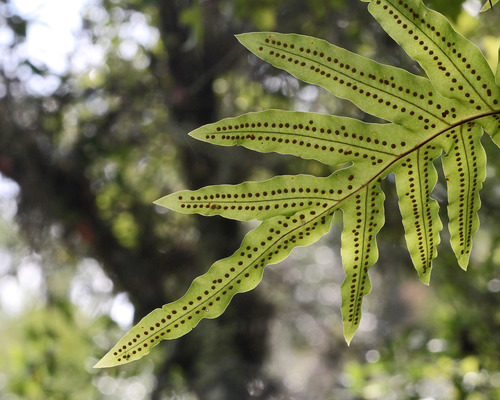
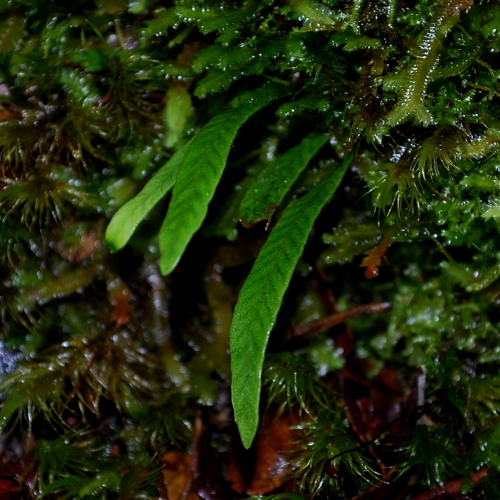
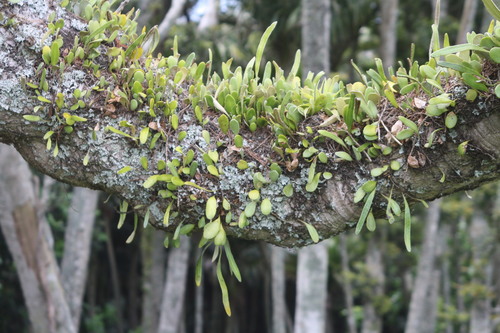
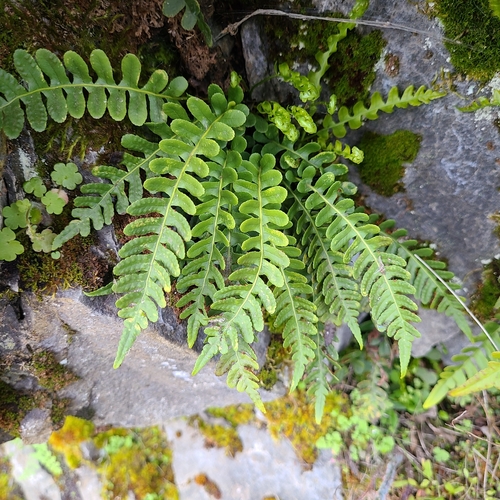
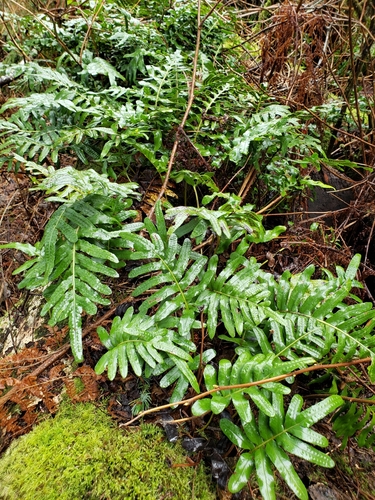
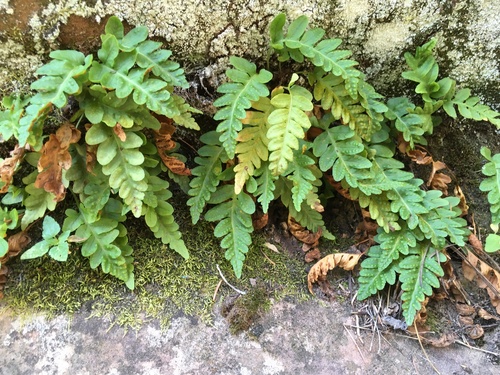
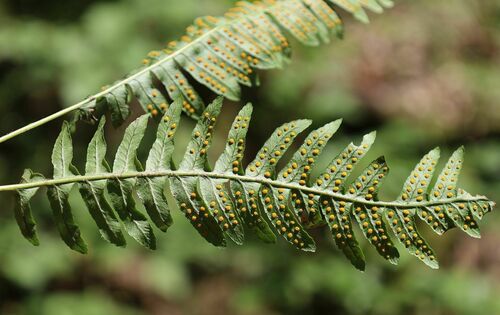
Polypodium vulgare, commonly called common polypody, is a fern that grows isolated fronds along a horizontal rhizome. Its fronds bear triangular leaflets, and reach 10 to 50 centimetres (3.9 to 19.7 in) in length. Fronds grow spaced apart from one another, and are divided all the way back to the central stem into 10 to 18 pairs of segments or leaflets. These leaflets measure 10–20 centimetres (3.9–7.9 in) long and 5–7 centimetres (2.0–2.8 in) wide, and become much shorter toward the tip of the frond. Leaflets are usually entire or slightly toothed, are somewhat wider at their base, and often touch neighboring leaflets at the base. They grow in an alternating arrangement, with leaflets on one side of the stem slightly offset from those on the opposite side. Its petioles have no scales. Sori develop on the underside of the fronds, and range in color from bright yellow to orange when young, turning dark grey as they mature. Sporulation occurs from July to September, and this species disperses its spores via anemochory, or wind dispersal. Identification of Polypodium vulgare is challenging. It forms a unique, complex species, and subtle differences between other Polypodium species further complicates identification and taxonomic classification. Only four living clades of this species currently exist, and it is thought that geographic isolation led to substantial divergence within the species. Key identifying traits for this species include its leathery-textured fronds, circular sori, and lateral veins that fork three to four times. Within the Polypodium genus, P. vulgare has the northernmost distribution. The combination of these shared traits allows for correct identification. Polypodium vulgare is distributed across western Europe, North Africa, Northern Europe, and parts of Asia. In Britain and Ireland, it is widespread across most regions except the drier areas of eastern England, and is most abundant in the high humidity of western and northern uplands, growing from sea level up to 760 m in altitude. It is very common in France, where it occurs up to 2,000 metres (6,600 ft) in altitude. It is also quite common in Scandinavia and the Carpathian Mountains. It is an introduced invasive species in New Zealand, where it has begun spreading into the wild. Common polypody is a hardy, highly adaptable species that typically grows in the northern temperate zone. It can be found in shaded and semi-shaded locations. It is a lithophyte, meaning it grows on rocks, and occurs in moss on old walls, cliffs, and in rock cracks, as well as in rocky undergrowth. It also grows as an epiphyte on mossy trees, and can mature equally well growing epiphytically or on the ground. It can grow as an epiphyte regardless of the height or branching pattern of the host tree it grows on, though it grows best when rooted in the crotch of a forked tree, where it can collect more water, sunlight, and minerals. Its evergreen leaves let it absorb sunlight during seasons with low light levels, an evolutionary advantage in deciduous forests. For cooking, the rhizome of P. vulgare has a bittersweet taste, and has been traditionally used in some confectionery items such as nougat for its aromatic properties. In 1971, a saponin called osladin was discovered in its roots. Osladin was thought to be the compound responsible for its sweet taste, with a relative sweetness 500 times sweeter than sugar by weight. The dried rhizome is used in herbal medicine as a purgative and vermifuge, effects attributed to phytoecdysteroids present in the rhizome. Because of its history of use as an herbal remedy, this species is recognized by the European Medicines Agency. The fronds contain phenolic acids and flavonoids, compounds that speed up cell regeneration to aid wound healing and help combat age-related diseases.