About Polypodium glycyrrhiza D.C.Eaton
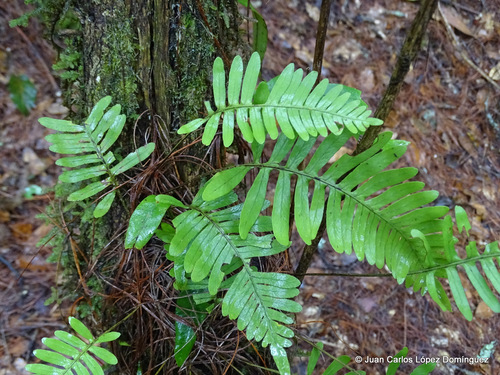
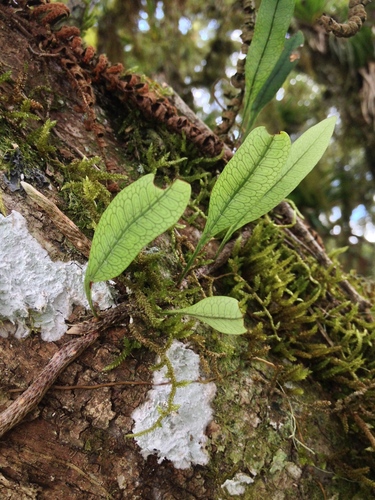
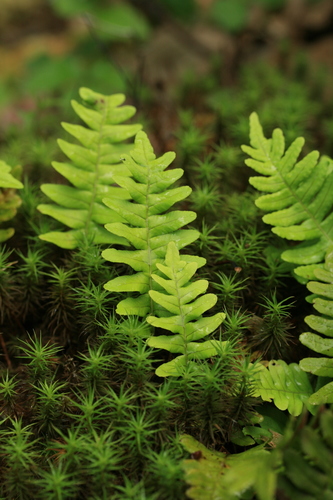
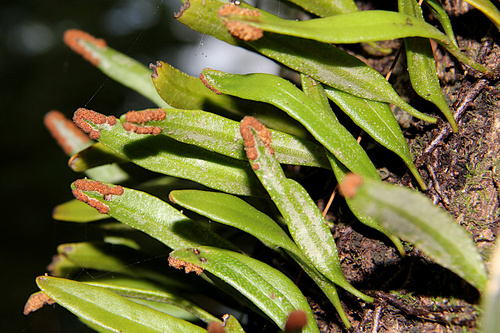
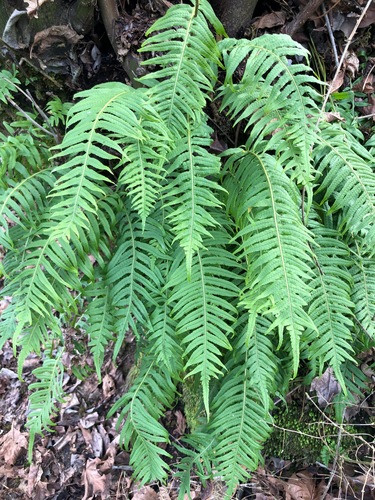
Polypodium glycyrrhiza D.C.Eaton, commonly known as licorice fern, grows single scattered fronds along a thick, creeping rhizome. Its genus name Polypodium, meaning "many-footed", refers to this rhizome structure. The fronds are once-divided, triangular, with finely toothed margins and pointed leaflets, and they have parallel venation. Fronds are usually at least one foot long, and can grow over two feet under good conditions; they are much smaller when growing conditions are poor. When sori develop on the underside of the frond, small bump-like protrusions appear in matching positions on the upper leaf surface. The creeping rhizome causes fronds to emerge at different points, giving them an apparently random placement. The rhizome is reddish-brown and has a sweet licorice flavor. As a fern, P. glycyrrhiza reproduces via spores. Spores develop in two rows of sori, which appear as large spots on the undersides of fronds. Sori range in color from yellow to orange to brown. Unthriving plants may produce no sori, or only patchy sori that do not form neat rows. Licorice fern can grow across ground, over rocks, or as an epiphyte, most often on moss-covered Acer macrophyllum. This species is not closely related to Glycyrrhiza glabra, the flowering plant that produces commercial licorice. Licorice fern is primarily found in a narrow near-coastal strip stretching from southern Alaska, through southwestern Yukon Territory, western British Columbia, Washington, Oregon, to California, with a separate disjunct population in Idaho. It prefers moist environments, and is typically found on wet ground, wet rocks, moss-covered tree trunks in very wet areas, and on logs, and is occasionally seen growing on fallen trees. It is strongly associated with bigleaf maple (Acer macrophyllum). This fern is mycorrhizal, and forms root associations with fungal hyphae. It grows and photosynthesizes during the mild, wet cold season, taking advantage of deciduous tree substrates when most other temperate plants are dormant. It only grows in lowland habitats below 600 meters (2,000 ft). Licorice fern is cultivated as an ornamental garden plant. The cultivar 'Longicaudatum' has received the Royal Horticultural Society's Award of Garden Merit. A number of indigenous groups, including the Squamish, Shishalh, Comox, Nuxalk, Haida, and Kwakwaka'wakw, chew licorice fern for its sweet flavor. Its rhizomes are also commonly used medicinally to treat colds and sore throats.