About Polypodium amorphum Suksd.
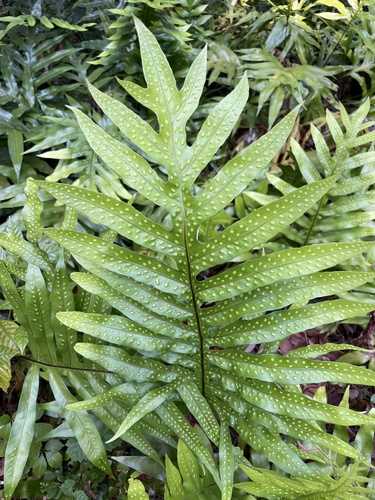
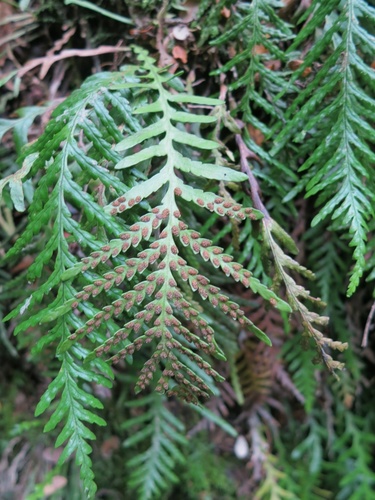
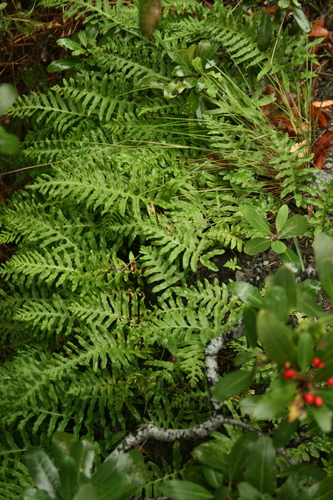
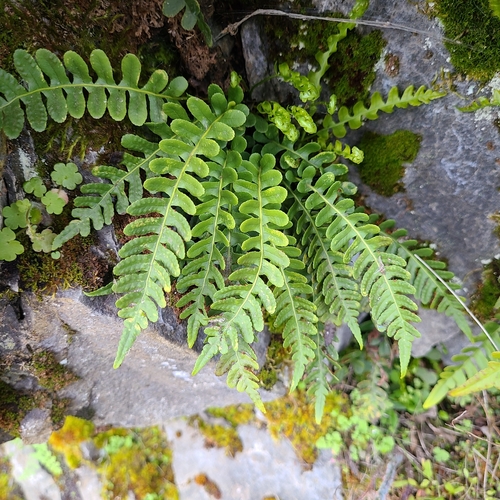
Polypodium amorphum Suksd. grows from a creeping rhizome that typically grows along rock crevices. The rhizome is covered in light brown scales that darken as the rhizome ages. Individual leaves grow singly from the rhizome, and do not form a centralized tuft. Leaves reach a maximum length of 30 cm, though they are usually much shorter. The petiole is slender, reaching up to 1.5 mm in diameter. Leaf blades are oblong, or rarely deltate, and can grow up to 4 cm wide; their texture is somewhat leathery. The rachis is sparsely scaly to completely glabrous. Pinnule margins range from entire to crenulate, and the pinnule apex ranges from rounded to broadly acute. The leaflets of this species are usually shorter and more rounded than other Polypodium ferns that share its native range. Sori are usually visible on the upper surface of leaflets as bump-like protrusions. On the underside of the leaf, sori are located between the pinnule midrib and margin, ranging from midway between the two structures to nearly marginal. Sori are less than 3 mm in diameter, and circular when immature. In spring and early summer, gland-rich sporangiasters are nestled between the sporangia. They are very small, and can only be observed with close, magnified inspection. Polypodium amorphum differs from the closely related Polypodium hesperium because its leaves persist for two years, and it produces sporangiasters. This fern is native to the Pacific Northwest of North America, with a range extending from southern British Columbia to northern Oregon. It grows in the Olympic Mountains, and on both sides of the Cascade Range crest. On the drier eastern side of the Cascades, it only grows in damp, high elevation locations. Polypodium amorphum grows mostly in moist rock crevices in mountain habitats up to the subalpine zone.