About Polyplectron inopinatum (Rothschild, 1903)
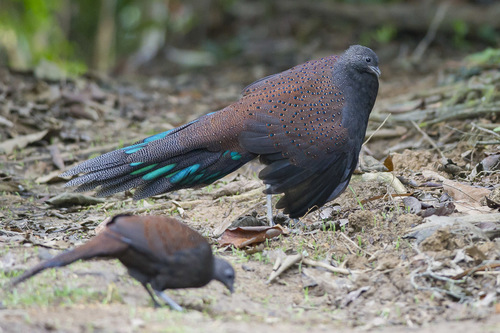
The mountain peacock-pheasant (Polyplectron inopinatum), also called Rothschild's peacock-pheasant or mirror pheasant, is a medium-sized pheasant that grows up to 65 cm in length. Its overall plumage is blackish brown, it has small ocelli and long graduated tail feathers, and males and females have similar general morphology. The male has metallic blue ocelli on its upperparts, green ocelli on its 20-feather tail, and two spurs on its legs. The female has black ocelli on its upperparts, no spurs on its legs, and an 18-feather tail; it is also smaller and duller in color than the male. This is a shy and elusive bird, endemic to and distributed exclusively in the montane forests of the central Malay Peninsula. Its diet consists mainly of berries, beetles, and ants. Data from mitochondrial DNA cytochrome b and D-loop, as well as nuclear ovomucoid intron G, confirms that this species belongs to a clade that also includes the bronze-tailed peacock-pheasant, Germain's peacock-pheasant, and grey peacock-pheasant (Kimball et al. 2001). Molecular data suggests, though not with high confidence, that this species diverged from mainland Southeast Asian stock earlier than the bronze-tailed peacock-pheasant. This result is considered quite unreliable, because the species' biogeography, derived plumage, and status as a peninsular mountain endemic indicate it is descended from a fairly small founder population, which would confound molecular analyses. What is clear is that the mountain peacock-pheasant evolved from mainland Southeast Asian stock, probably during the Late Pliocene to Early Pleistocene, between 3.6 and 1 million years ago. Contrary to long-held opinion, the unique wing and tail pattern of this species is an autapomorphy, and the southern clade species formerly separated into the genus Chalcurus are probably not each other's closest relatives. Due to ongoing habitat loss, small population size, and limited range, the mountain peacock-pheasant is evaluated as Vulnerable on the IUCN Red List of Threatened Species. It is listed on Appendix III of CITES in Malaysia.