About Polyphylla barbata Cazier, 1938
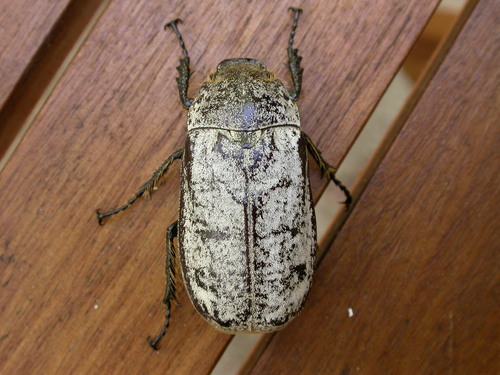
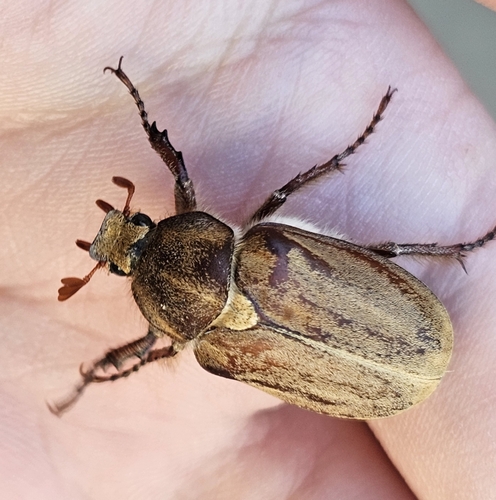
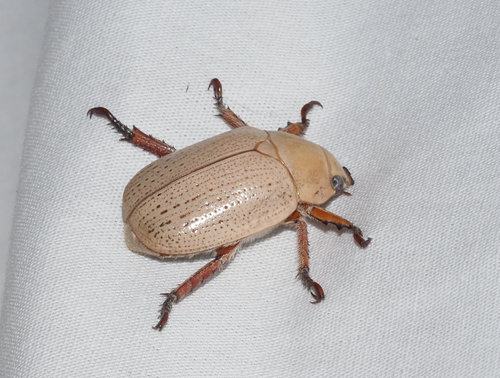
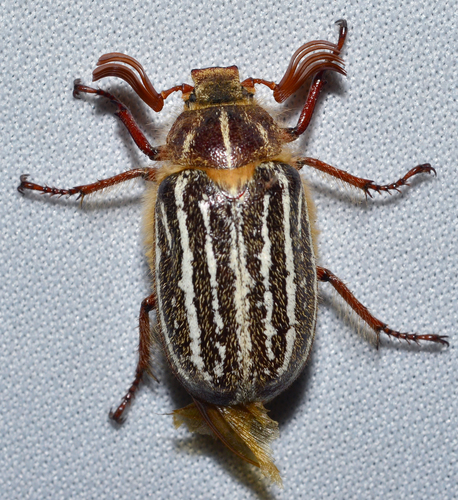
Polyphylla barbata is a rare beetle species with the common name Mount Hermon June beetle. It is endemic to California, and occurs only in Santa Cruz County. There is only one known single population of this beetle, found across an area smaller than 1,500 acres (6.1 km²). It is a federally listed endangered species of the United States. This beetle grows to about 2 centimeters long, and is black and brown in color with broken white longitudinal stripes on its back. Its elytra are covered in a thin layer of hairs. Females are slightly larger than males. Females spend most of their time underground, and only emerge to mate with males. Males fly between mid-June and late July, and are most active between 8:45 and 9:30 pm. Their wings produce a crackling sound during flight. This beetle spends most of its life cycle underground as a larva, and adult individuals may not feed at all. Larvae likely feed on plant roots and mycorrhizal fungi. The full life cycle may take 2 to 3 years, but male adults may live only one week after reaching maturity, and females usually die shortly after laying eggs. This species was first formally described in 1938, from a specimen collected at Mount Hermon, California. It is restricted to the Zayante sandhills, a region around Mount Hermon, Scotts Valley, and Ben Lomond in the Santa Cruz Mountains. This same region is also home to another endangered arthropod, the Zayante band-winged grasshopper (Trimerotropis infantilis). Its habitat consists of ponderosa pine forest and chaparral, with open, sandy pockets within the surrounding volcanic hills. The area hosts several rare, threatened plant species, including the Ben Lomond wallflower (Erysimum teretifolium), the Ben Lomond spineflower (Chorizanthe pungens ssp. hartwegiana), and the Santa Cruz cypress (Callitropsis abramsiana). Over 40% of the Zayante sandhills region has been lost to human activity including development and sand mining. Most of the beetle's remaining habitat lies near active sand mining operations. Fire suppression has altered the area's natural plant community, replacing fire-tolerant plant species with other types of vegetation.