About Polyphlebium venosum (R.Br.) Copel.
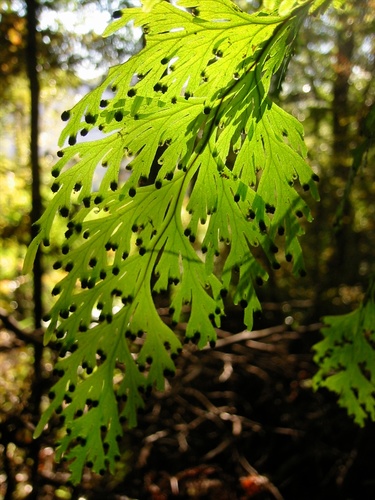
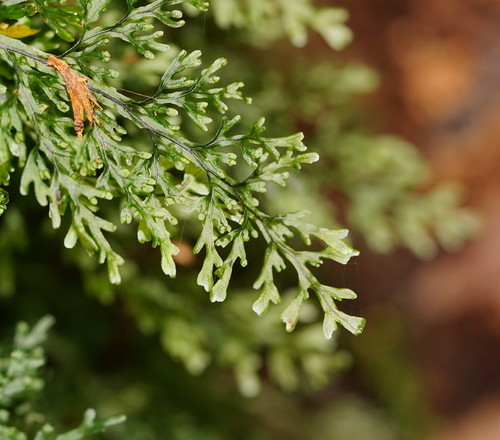
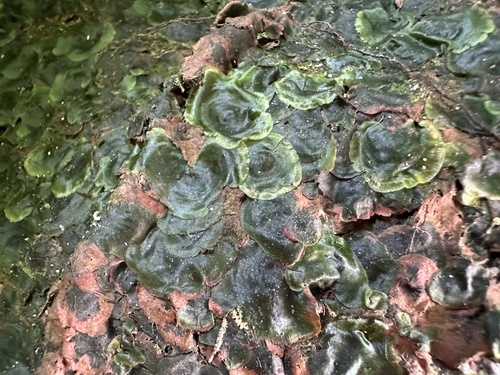
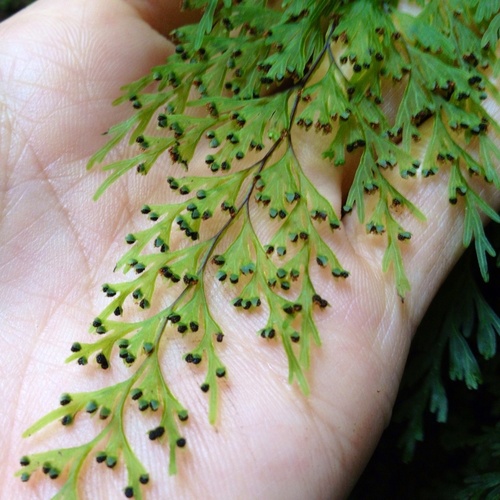
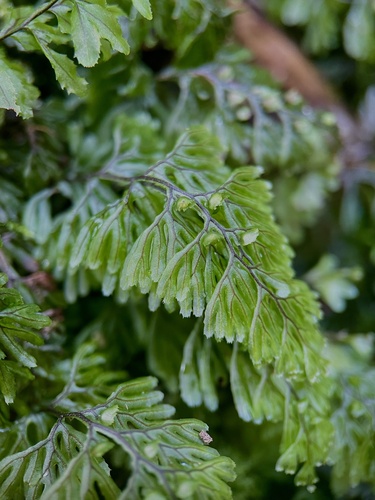
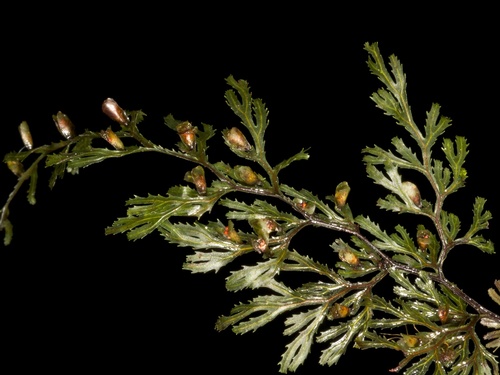
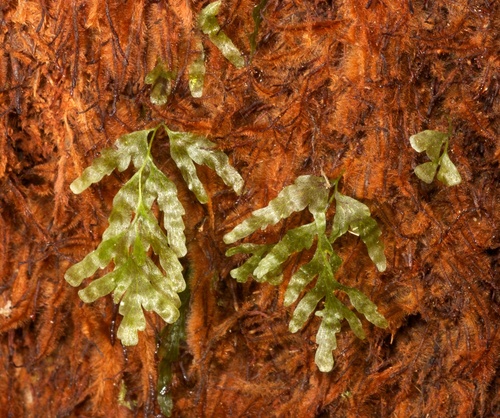
The scientific name of this species is Polyphlebium venosum (R.Br.) Copel. In the sporophyte stage, it has a branched, creeping, very fine rhizome that is densely covered with tiny pale brown hairs. Fronds are well spaced, pendent, 5–15 cm long, delicate and translucent; the stipe and rachis are thread-like. The lamina is pale green, long and narrow, irregular in outline, and ranges from simply lobed to pinnately divided. Pinnae are sometimes very long and hang almost parallel to the main rachis, while lower pinnae are often very small and widely spaced. Margins of pinnae or segments are wavy or broadly crenate; ultimate segments are blunt and broad, measuring 2–6 mm across; veins are prominent and repeatedly forked. Sori are marginal and immersed, borne singly on short lateral lobes near the base of pinnae; the indusium is narrowly trumpet-shaped, 2–4 mm long; the fine receptacle projects 10 mm or more. The gametophyte is a branching uniseriate filament that bears numerous small, stalked antheridia. Each antheridium has a simple wall and an operculum, which is raised or shed to let spermatozoids escape. Archegonia, which have straight necks and tiers of four to six neck cells, are borne on special structures called archegoniophores. Polyphlebium venosum is found only in wet forests of Australia and New Zealand. In Australia, it is restricted to the eastern states of Tasmania, Victoria, New South Wales and Queensland. Because the entire plant is only one cell layer thick, it is extremely prone to desiccation in hot or dry environments. This is the main reason it grows as a mat on the shaded side of Dicksonia antarctica. P. venosum is not at risk of worldwide extinction, but extreme events like large-scale wildfires can reduce population sizes and worsen the impacts of anthropogenic disturbances. Due to its heavy reliance on D. antarctica, the species has a limited dispersion rate, which can be stopped entirely by dry landscapes that act as geological boundaries. Like other ferns, P. venosum undergoes alternation of generations, which consists of two sexual stages: the diploid sporophyte and the haploid gametophyte. The sporophyte stage is made up of adult ferns that release numerous spores. These spores then settle on the trunks of D. antarctica in moist, sheltered habitats. Spores germinate within a few days and form a one-cell-layer-thick, heart-shaped prothallus. In ferns, the prothallus may require several months to several years of development to reach sexual maturity. Male antheridia mature and release their gametes earlier than female archegonia, as an adaptation to avoid self-fertilisation. The prothallus can reproduce asexually through the release of gemmae, which develop rhizoids, filaments and antheridia or more gemmae after germination. The prothallus can also reproduce itself vegetatively through regeneration. Once established, P. venosum spreads to surrounding substrate via its extensively creeping rhizomes. Spores of P. venosum take two days to germinate after sowing, and are on average only viable for 48 days. After two weeks, only one ten-billionth of the original spores survive. 90% of all released spores are distributed in the immediate vicinity of the parent sporophyte. The short-lived nature of P. venosum's spores, compared to spores of other ferns, reduces their likelihood of successful long-distance dispersal.