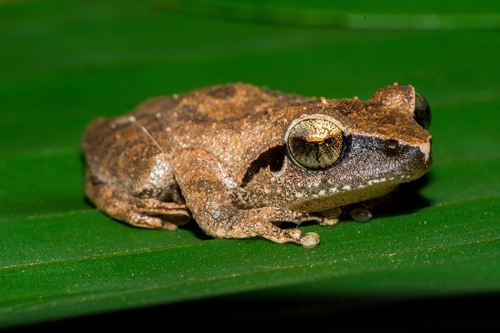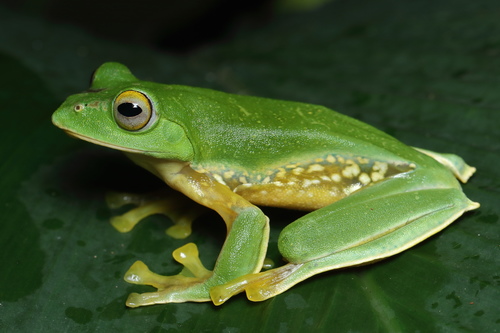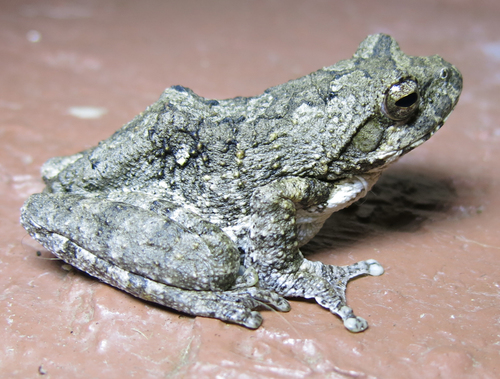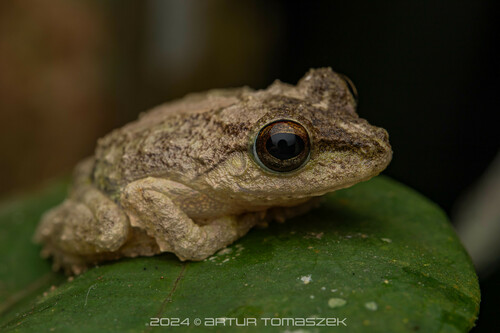
About Polypedates maculatus (Gray, 1830)
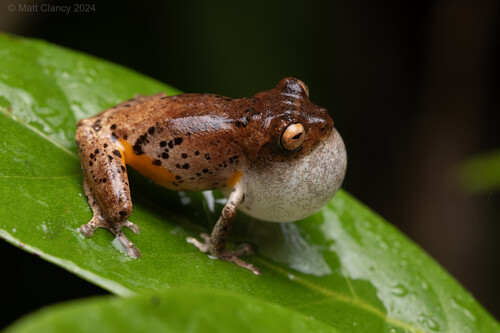
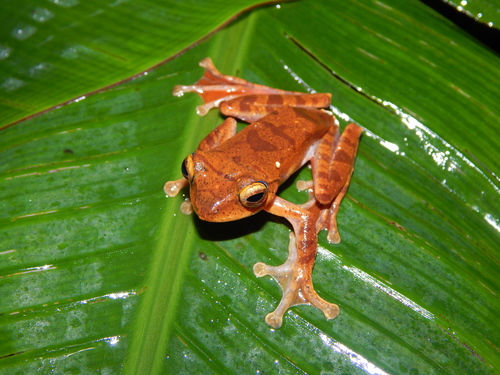
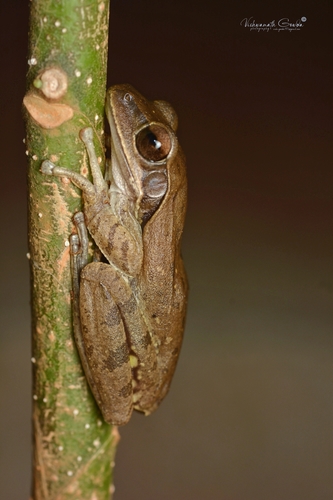
Adults of this frog species reach a body length of approximately 7 to 8 centimeters. The dorsal side of the body is most often brownish, yellowish, greyish, or whitish, marked with darker spots or markings; an hourglass-shaped marking on the back of the head and upper back is rare. The loreal and temporal regions are dark, and a pale stripe runs along the upper lip. The posterior surface of the thighs bears round yellow spots, which are typically separated by a dark brown or purplish network. Dorsal skin is smooth, while the belly and underside of the thighs are granulated, and a distinct skin fold runs from the eye to the shoulder. Males of the species have internal vocal sacs. Vomerine teeth are arranged in two roughly oblique series positioned between the choanae, or starting near the inner front edge of the choanae. The skin of the head is not fused to the underlying skull. On each side of the skull, a more or less developed bony arch runs from the posterior edge of the frontoparietal bones to the squamosals; this arch may be slender and partially ligamentous, or very thick and swollen. The snout is pointed with a rounded tip, and is roughly the same length as the diameter of the eye socket. The canthus rostralis is distinct, and the loreal region is concave. The nostril is positioned much closer to the tip of the snout than to the eye. The space between the eyes is broader than the width of the upper eyelid. The eardrum is approximately three-quarters the diameter of the eye. The fingers have only minimal webbing, while the toes are two-thirds webbed. The adhesive disks on the tips of the fingers and toes are moderately sized; the disk of the third finger measures between two-fifths and one-half the diameter of the eye. The subarticular tubercles are moderately sized. When the hind leg is stretched along the side of the body, the tibiotarsal joint reaches between the eye and the tip of the snout, or reaches the eye itself. This species is widespread across Bhutan, India, Nepal, and Sri Lanka, as well as from western and southern Bangladesh to Chittagong District; its range may also extend into adjacent parts of China and Myanmar. It is a common and adaptable species, and is currently listed as Least Concern by the IUCN. Individuals often use regular day roosts. Their advertisement call is a sudden, short, rapid series of rattling rat-tat sounds. They coat their bodies with skin secretions made of mucus and lipids, which helps reduce moisture loss. At higher temperatures, they secrete fluid through the skin (a behavior described as "sweating"), pant, and develop lighter skin coloration. In southern India, these frogs are a common household nuisance, as they enter homes searching for food. Using their webbed feet, they can climb walls to reach upper floors, and enter buildings through open windows.