About Polypedates leucomystax (Gravenhorst, 1829)
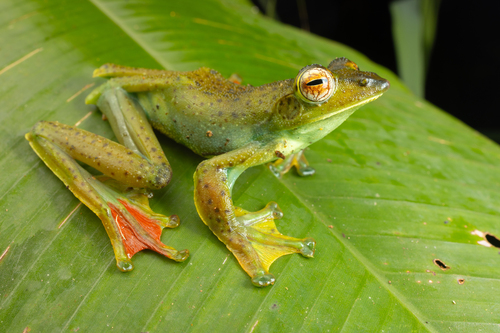
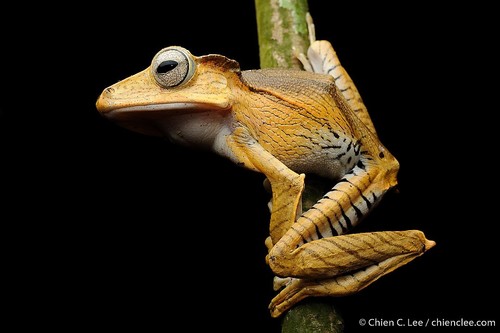
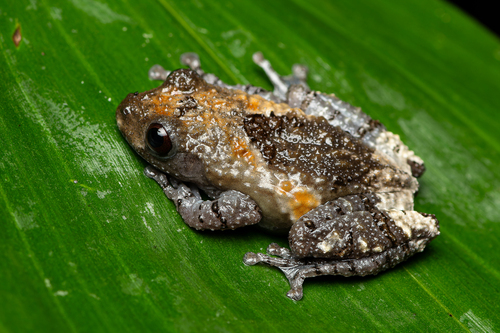
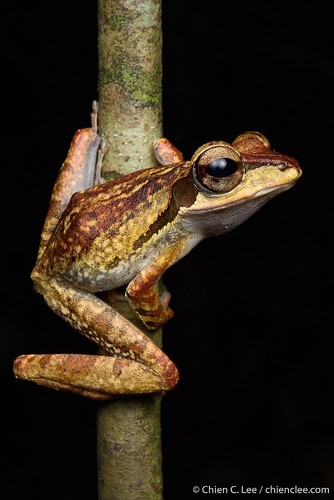
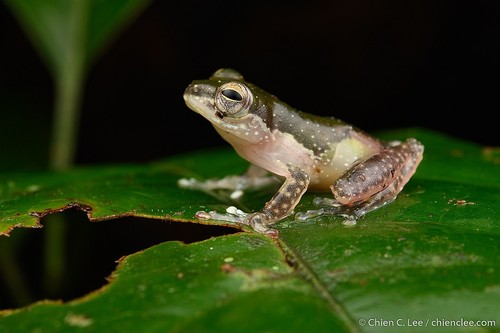
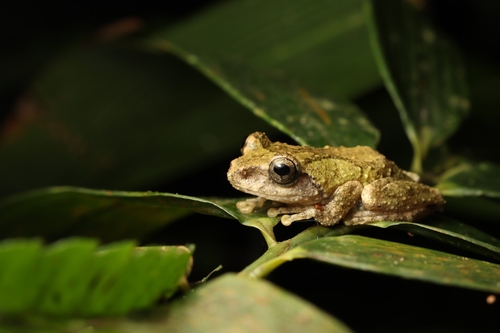
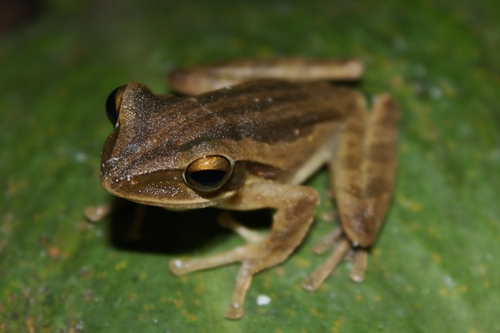
Polypedates leucomystax, commonly known as the common tree frog, is a species of shrub frog in the family Rhacophoridae. Males reach a snout–vent length of approximately 3.7–5.0 centimetres (1.5–2.0 in), while females reach 5.7–7.5 centimetres (2.2–3.0 in). The body of these rather small shrub frogs is moderately slender, ovoid, and slightly flattened on the dorsal side. The dorsal skin is smooth. Body coloration is quite variable, ranging across shades of gray, green, yellow, reddish, and dark brown. Individuals are usually irregularly mottled, and often have four stripes running along the back. A distinct white spot sometimes appears at the tip of the snout. Eyes are positioned on the sides of the head. The hind feet are webbed, and the feet have clear, large adhesive cushions, a trait typical of leaf frogs. Earlier taxonomic treatments thought P. leucomystax occurred below Vietnam's Red River and in western Yunnan, with P. megacephalus found above the Red River and in Northeast India. However, recent genetic studies show the natural barriers separating the two species are the Isthmus of Kra and the Tenasserim Range: P. leucomystax is found below the isthmus and west of the range. The Polypedates leucomystax species complex began diverging in the Pliocene, and spread rapidly after the Pleistocene due to human activity. Its range has recently expanded in the Philippines and Indonesia following widespread conversion of forests to agricultural land. It is also commonly transported in trans-island agricultural shipments. Lineages on the Indochina mainland show higher genetic diversity. In Indonesia, it occurs across the archipelago in Borneo, Mentawai, Sumatra, Java, Sulawesi, Bali, Lombok, the Natuna Islands, the Anambas Islands, Sumbawa, Sumba, Flores, and Timor, and has been introduced to Papua. In Japan, where it has been introduced, it occurs on the islands of Okinawa, Tonaki, Kurima, Miyako, Ie, Iheya, Izena, Sesoko, and Yabuchi. Brown et al. (2010) recognized four major haplotype clades of P. leucomystax, and all clades except the southern Sunda region clade are likely cryptic species. These clades are: southern Sunda region, which includes Java and Sumatra, corresponding to "true" P. leucomystax with a type locality of Java; northern Sunda region, which includes Peninsular Malaysia, northern Borneo (Sarawak and Sabah), and southern Philippines, and is the most basal clade; the Sulawesi clade, for which the name P. celebensis sp. nov. has been suggested, with four distinct sub-clades corresponding to each of the four peninsular prongs of Sulawesi Island; and the northern Philippines clade, for which the name P. quadrilineatus sp. nov. has been suggested, which includes a basal variety from Lombok. Divergent varieties that are either P. cf. leucomystax or P. cf. megacephalus have been recorded in southern China (including Hainan) and Vietnam. Its natural habitats include subtropical or tropical dry forests, subtropical or tropical moist lowland forests, subtropical or tropical moist montane forests, subtropical or tropical moist shrubland, subtropical or tropical seasonally wet or flooded lowland grassland, rivers, intermittent rivers, freshwater lakes, intermittent freshwater lakes, freshwater marshes, intermittent freshwater marshes, freshwater springs, rocky shores, coastal freshwater lagoons, arable land, pastureland, plantations, rural gardens, urban areas, water storage areas, ponds, aquaculture ponds, irrigated land, seasonally flooded agricultural land, and introduced vegetation.