About Polyozellus multiplex (Underw.) Murrill
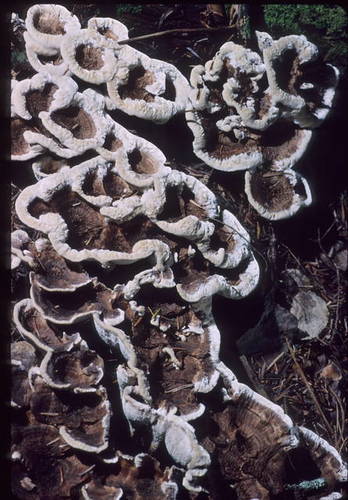
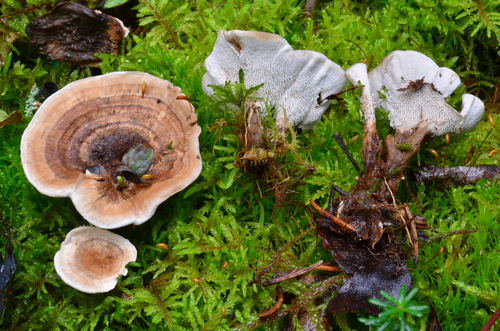
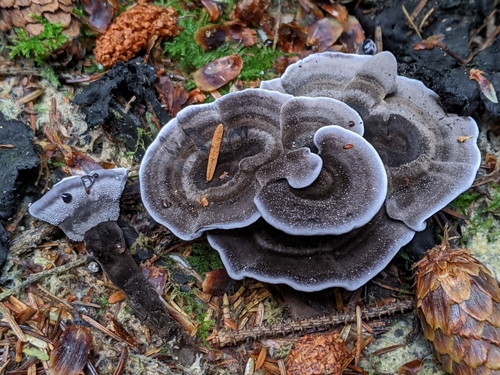
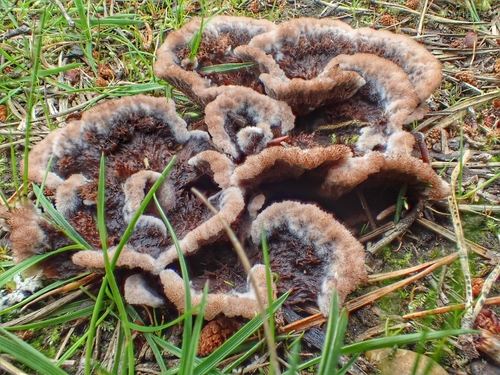
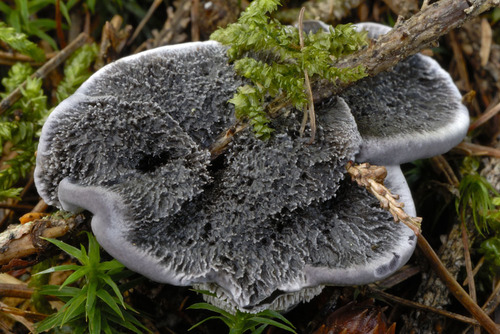
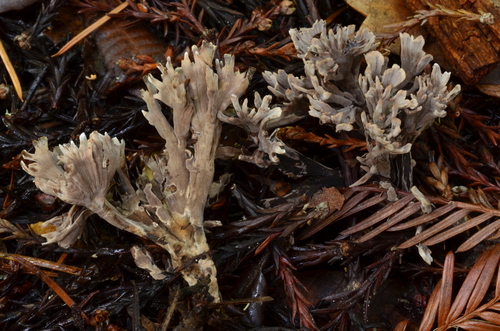
Polyozellus multiplex, commonly known as the black chanterelle, produces fan- or funnel-shaped fruit bodies that grow clustered together on the ground. Clusters are typically 15 centimeters (6 in) tall and 30 cm (11.8 in) wide, and exceptional masses can reach up to 1 meter (3.3 ft) in diameter. Individual caps measure 3–8 cm (1.2–3.1 in) wide, and are violet-black with initially whitish edges. Their surface is glaucous, covered by a white powdery accumulation of spore deposit. The upper cap surface may be zonate, marked with multiple concentric texture zones from areas of fine tomentum (fine hairs). Cap edges are lobed and wavy, and covered in a layer of very fine hairs. The underside of the cap holds the fertile spore-producing tissue called the hymenium, which usually has shallow, crowded wrinkles or veins that match the color of the cap surface or are paler. Color varies by collection location: for example, specimens collected in Alaska are more often jet-black with a dark gray underside. The stem is dark purplish-black with a smooth (glabrous), dry surface; stems are often fused at their base. Stems typically grow up to 5 cm (2.0 in) long and 1.5–7 cm (0.6–2.8 in) wide. The flesh is dark violet, soft but brittle, and the spore print is white. Microscopically, spores are roughly spherical to broadly ellipsoid, covered with small wart-like projections called tubercules, and measure 6–8.5 by 5.5–8 μm. Spores are hyaline (translucent or colorless) when viewed microscopically. Chemical reactions help identify the spores: in potassium hydroxide (KOH), spores turn slightly green; spores are not amyloid, meaning they do not absorb iodine when treated with Melzer's reagent; and they are acyanophilous, meaning they do not readily take up methyl blue stain. The cystidia in the hymenium are filamentous, measuring 3–4 μm wide by 28–40 μm long. The cap's outer tissue layer, the cuticle (or pileipellis), is made of interwoven hyphae, and stains olive-green in KOH. Clamp connections are present, but do not occur at all cell partitions. The spore-bearing basidia measure 32–38 by 5–6 μm and produce four spores each. Polyozellus multiplex is an ectomycorrhizal species: its fungal hyphae form a mutualistic association with plant roots, and generally do not penetrate the cells of the plant roots. The fungus grows in coniferous woods under spruce and fir, occurring more frequently at higher elevations. It is most commonly found in summer and fall. This species has a northern and alpine distribution, and is rarely encountered. Confirmed collections have been made in the United States (including Maine, Oregon, Colorado, New Mexico, and Alaska), Canada (Quebec and British Columbia), China, Japan, and Korea. In North America, collections are still being re-catalogued to reflect the recent separation of 5 distinct species within the genus Polyozellus. This species' disjunct distribution across North America and East Asia is also seen in many other fungal species. P. multiplex is also found in the Queen Charlotte Islands, where it is commercially harvested.