About Polyodon spathula (Walbaum, 1792)
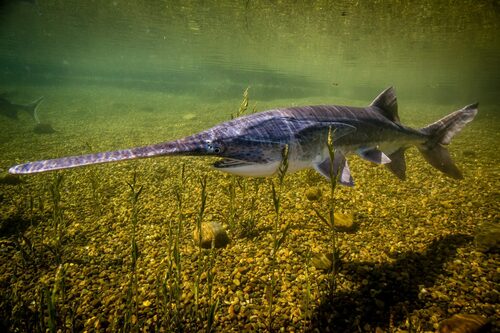
Polyodon spathula, commonly called American paddlefish, are among the largest and longest-lived freshwater fish native to North America. They have a shark-like body, with an average adult length of 1.5 m (4.9 ft) and average weight of 27 kg (60 lb), and can live more than thirty years. For most populations, the median age is five to eight years and the maximum age is fourteen to eighteen years. The age of American paddlefish is best determined through dentary studies, which are most often performed on fish harvested during snagging season, a popular sport fishing activity in parts of the United States. To do this, the dentary is removed from the lower jawbone, all remaining soft tissue is cleaned away, and it is cross-sectioned to expose annual growth rings. These rings are counted the same way growth rings are counted to age a tree. Dentary studies show some individuals can live 60 years or longer, and females typically live longer and grow larger than males. American paddlefish have smooth skin and skeletons that are almost entirely cartilaginous. Their eyes are small and face laterally. They also have a large, tapering operculum flap, a large mouth, and a flat, paddle-shaped rostrum that makes up roughly one-third of their total body length. During the early developmental stages from embryo to hatchling, American paddlefish have no rostrum; it begins to form shortly after hatching. The rostrum is an extension of the cranium, unlike the long snouts of other fish which extend from the upper and lower jaws or the olfactory system. Other identifying characteristics include a deeply forked heterocercal caudal fin and dull, often mottled coloration: their dorsal side ranges from bluish gray to black, and fades to a whitish underbelly. American paddlefish are highly mobile and well adapted to life in rivers. They inhabit a wide range of riverine habitats across most of the Mississippi Valley and adjacent Gulf slope drainages. They are found most often in deeper, low-current areas including side channels, oxbows, backwater lakes, bayous, and tailwaters below dams. Individuals have been recorded moving more than 2,000 mi (3,200 km) within a single river system. They are endemic to the Mississippi River Basin; their historic range extended from the Missouri and Yellowstone rivers in the northwest to the Ohio and Allegheny rivers in the northeast, and from the headwaters of the Mississippi River south to its mouth, reaching the San Jacinto River in the southwest and the Tombigbee and Alabama rivers in the southeast. They have been extirpated from New York, Maryland, and Pennsylvania, as well as from most of their peripheral range in the Great Lakes region, including Lake Huron and Lake Helen in Canada. In 1991, Pennsylvania launched a reintroduction program using hatchery-reared American paddlefish to establish self-sustaining populations in the upper Ohio and lower Allegheny rivers. In 1998, New York started a stocking program upstream in the Allegheny Reservoir above Kinzua Dam, and added a second stocking in 2006 in Conewango Creek, a relatively unaltered portion of the species' historic range. Free-ranging adults captured by gill nets have since been recorded in both Pennsylvania and New York, but there is no evidence of natural reproduction in these areas. Currently, the species is found in 22 U.S. states, where it is protected under state and federal law; 13 of these states allow either commercial or sport fishing for American paddlefish. American paddlefish populations have declined dramatically, primarily due to overfishing and habitat destruction. In 2004, the species was listed as Vulnerable (VU A3de ver 3.1) on the IUCN Red List of Threatened Species. In 2022, the status was updated to VU A2cd across its entire range, following an assessment by the U.S. Fish & Wildlife Service. The assessment concluded that an overall population reduction of at least 30% may occur within the next 10 years or three generations, caused by actual or potential exploitation levels and impacts from introduced taxa, pollutants, competitors, or parasites. American paddlefish are filter-feeding pelagic fish that require large, free-flowing rivers with braided channels, backwater areas, and zooplankton-rich oxbow lakes, plus gravel bars for spawning. Dams built along rivers such as the Missouri River have impounded large American paddlefish populations, and blocked their upstream migration to spawning shoals. Channelization and groynes or wing dykes have narrowed rivers and altered flow, destroying critical spawning and nursery habitat. As a result, most impounded populations are not self-sustaining, and must be stocked to maintain a viable sport fishery. Since the species was first described in the late 1700s, scientists have debated the function of the American paddlefish's rostrum. Early hypotheses suggested the rostrum was used to excavate bottom substrate, or acted as a balancing mechanism and navigational aid. However, 1993 laboratory experiments using advanced electron microscopy confirmed that the rostrum is covered in tens of thousands of sensory receptors. These receptors are structurally similar to the ampullae of Lorenzini found in sharks and rays, and are passive ampullary-type electroreceptors that American paddlefish use to detect plankton. Clusters of these electroreceptors also cover the head and operculum flaps. The diet of American paddlefish consists primarily of zooplankton; recorded prey items include copepods, cladocerans such as Daphnia pulex, and ephemeropteran nymphs. Their electroreceptors can detect weak electrical fields that signal not just the presence of zooplankton, but also the individual feeding and swimming movements of zooplankton appendages. When a swarm of zooplankton is detected, the paddlefish swims forward continuously with its mouth fully open, forcing water over gill rakers to filter out prey. This feeding behavior is classified as ram suspension-feeding. Additional research suggests the paddlefish's electroreceptors may also act as a navigational aid to avoid obstacles. American paddlefish have small, undeveloped eyes that face laterally. Unlike most fish, American paddlefish barely respond to overhead shadows or changes in illumination. Electroreception appears to have largely replaced vision as their primary sensory modality, meaning the species relies heavily on electroreceptors to detect prey. However, the rostrum is not their only tool for detecting food. Some reports suggested that a damaged rostrum would leave American paddlefish unable to forage efficiently enough to maintain good health, but laboratory and field research does not support this claim. In addition to electroreceptors on the rostrum, American paddlefish have sensory pores covering nearly half of their skin surface, extending from the rostrum to the top of the head and down to the tips of the operculum flaps. Studies confirm that American paddlefish with damaged or shortened rostrums can still forage and maintain good health. American paddlefish are long-lived, late-maturing pelagic fish. Females do not reach sexual maturity and begin spawning until they are seven to ten years old, and some do not spawn until sixteen to eighteen years old. Females do not spawn every year; instead they spawn every second or third year. Males spawn more frequently, usually every year or every other year starting around age seven, and some do not begin spawning until nine or ten years old. American paddlefish begin their upstream spawning migration during early spring, and some start the migration as early as late fall. They spawn on silt-free gravel bars that would otherwise be exposed to air or covered by very shallow water, without the river level rises brought by snow melt and annual spring flooding. While access to preferred spawning habitat is essential, three specific environmental conditions must occur before American paddlefish will spawn. The water temperature must fall between 55 to 60 °F (13 to 16 °C); the longer photoperiod of spring triggers the biological and behavioral processes tied to increasing day length; and the river must have an appropriate rise and flow for successful spawning. Historically, the required combination of these precise environmental events only occurred once every 4 or 5 years, so American paddlefish did not spawn annually. American paddlefish are broadcast spawners, also called mass spawners or synchronous spawners. Gravid females release their eggs into the water over bare rock or gravel at the same time males release their sperm, and fertilization occurs externally. After release, eggs become sticky and attach to the bottom substrate. Incubation time varies with water temperature, but at 60 °F (16 °C) eggs hatch into larval fish after approximately seven days. After hatching, larval fish drift downstream into low-flow velocity areas where they forage for zooplankton. Young American paddlefish are poor swimmers, which makes them vulnerable to predation, so rapid first-year growth is critical to their survival. Fry can grow roughly 1 in (2.5 cm) per week, and by late July fingerlings measure around 5–6 in (13–15 cm) long. Growth rate is variable and highly dependent on food abundance, with faster growth occurring in areas with unlimited food. The feeding behavior of fingerlings differs from that of older juveniles and adults: fingerlings capture individual plankton one at a time, which requires detecting and locating individual Daphnia as they approach, then completing an intercept maneuver to capture the selected prey. By late September, fingerlings have developed into juveniles and measure around 10–12 in (25–30 cm) long. After the first year, growth rate slows and remains highly variable. Studies show that by age 5, the average growth rate is around 2 in (5.1 cm) per year, varying with food abundance and other environmental influences.

