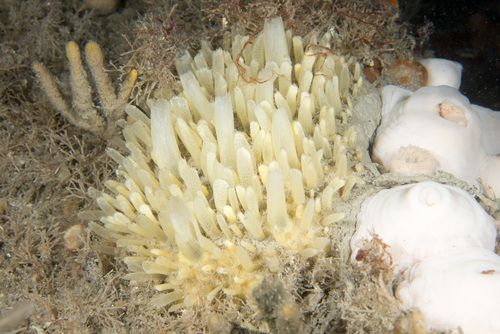
About Polymastia penicillus (Montagu, 1814)
Polymastia penicillus forms small cushions up to 3 cm (1.2 in) high, and can reach a diameter of 20 cm (8 in). A number of hollow, cylindrical papillae up to 3 cm (1.2 in) long project from its upper surface. Each papilla has an exhalant opening called an osculum at its tip, and many small inhalant pores on its sides, and the papillae are retractable. This sponge is pale yellow, and its papillae are often translucent or paler than the rest of its tissue. A similar species that shares the same habitat is Polymastia boletiformis. P. boletiformis is slightly darker yellow, forms a thicker, less-spreading cushion with darker papillae, and is less likely to have sediment settle on its surface, while P. penicillus often appears dirty. Polymastia penicillus is found in the North Atlantic Ocean, along the coasts of North America and Western Europe, including the North Sea, the English Channel, and the Mediterranean Sea. It most commonly grows in the shallow subtidal zone down to around 25 m (80 ft), but may sometimes be found at much greater depths. Its typical habitat is rock located near sandy areas, in waters with high levels of suspended particulate matter. Like other sponges, Polymastia penicillus draws water through its body, filters out bacteria and phytoplankton for food, and expels filtered water through its osculi. Sexual reproduction occurs during summer; larvae are expelled with outgoing water currents, and soon settle on the seabed to develop into juvenile sponges. Sponges have strong regenerative capabilities, and this species also reproduces asexually: detached fragments of the sponge settle and grow into new individual sponges. Polymastia penicillus has a symbiotic relationship with the bacterium Pseudovibrio sp. POLY-S9 strain. This bacterial strain has a very large genome that includes several bioactive gene clusters and many mobile DNA elements, which may allow the bacterium to survive in different hosts and habitats through genetic material exchange.


