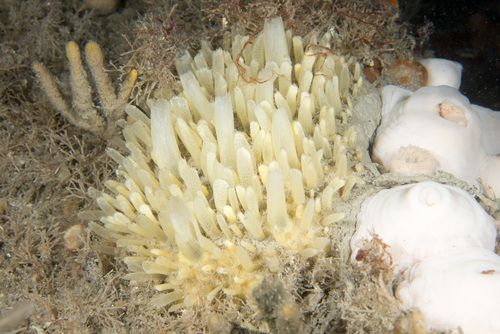
About Polymastia boletiformis (Lamarck, 1815)
Polymastia boletiformis forms small cushions or broad-based tissue masses up to 10 cm (4 in) in diameter, and adheres firmly to the substrate it grows on. Several hollow, cylindrical papillae up to 3 cm (1.2 in) long project from the sponge's upper surface. Each papilla has an osculum, an exhalant opening, at its tip, and many small inhalant pores on its sides. The mesohyl, a jelly-like layer located in the sponge's body wall, is stiffened by mineral spicules, which include large and small needle-like megascleres. This species has no microscleres. The texture of this sponge is smooth, firm yet supple, and its color ranges from yellowish-grey to yellow or orange. The papillae are contractile, and will bend over when the sponge is handled. The papillae are the same color as the rest of the sponge body, a trait that helps distinguish this species from the similar-looking Polymastia penicillus, Polymastia mamillaris, and Ciocalypta penicillus. Polymastia boletiformis inhabits temperate and cold waters across the western Atlantic Ocean, ranging as far south as the Gulf of Maine, as well as the Arctic Ocean and the eastern Atlantic Ocean, ranging as far south as the Bay of Biscay. It is common in Northern France, the Netherlands, and the British Isles. Its depth range extends from the littoral zone, where it can be found in rock pools, down to approximately 30 m (100 ft), and it has been found exceptionally much deeper at 2,300 m (7,500 ft). Its typical habitat is the tops of boulders and up-facing rock surfaces covered with sediment, where it grows alongside a mat of bryozoans and hydroids. It tolerates a wide range of salinity levels, and sometimes grows in estuaries. Like all other sponges, Polymastia boletiformis draws water through its body, filters out nutritious particles such as bacteria and phytoplankton, and expels excess water through its osculi. Sexual reproduction occurs during the summer, and the sponge's larvae are expelled along with outgoing water currents. The dorid nudibranch Doris adrianae feeds on this sponge. Secondary metabolites isolated from Polymastia boletiformis have shown antimicrobial activity, and extracts of the sponge contain previously undescribed steroid/amino acid conjugates.