About Polygonum arenastrum Boreau
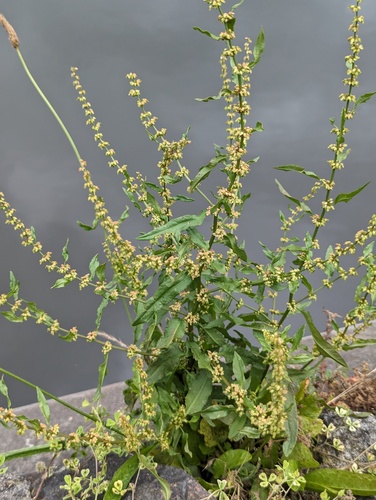
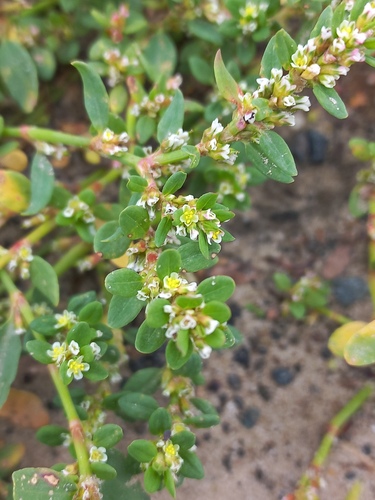
Polygonum arenastrum Boreau, commonly called knotweed, develops a deep taproot that can reach 46 cm (18 inches) deep. It grows well in compacted soil and survives drought conditions. Numerous wiry stems grow outward from the plant's center, giving the plant a mat-like appearance. Stems are very long, branching, and grow in a zigzag pattern. Leaves are alternate, oblong, hairless, bluish-green, and measure 12 to 37 mm (1⁄2 to 2+1⁄2 inches) long. Each node has a short leaf stalk closely surrounded by papery stipules. Stem nodes are slightly swollen and look somewhat like "knots", which gives the plant its common name of knotweed. The plant produces inconspicuous, petal-less flowers that grow along the entire length of stems; flower color ranges from white to green, and the sepals are pinkish with white edges. Seeds are egg-shaped, dark reddish brown, and have a smooth, shiny surface. In the United States, this knotweed can be mistaken for the native plant spotted spurge. An easy way to distinguish the two is to break off a stem: spotted spurges contain milky sap, while this knotweed does not. Because it grows well in compacted soils, common knotweed is most often found on brown-field sites, along roadsides and pavements, in driveways, in heavily foot-trafficked turf grass, and in gardens.