About Polycyathus muellerae (Abel, 1959)
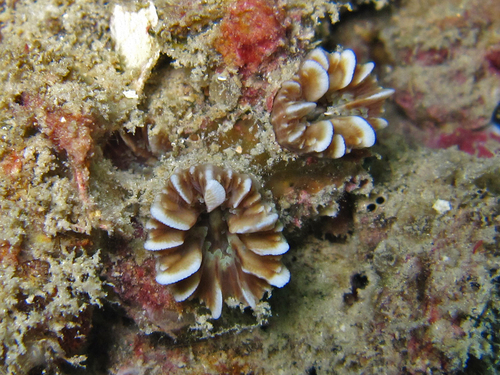
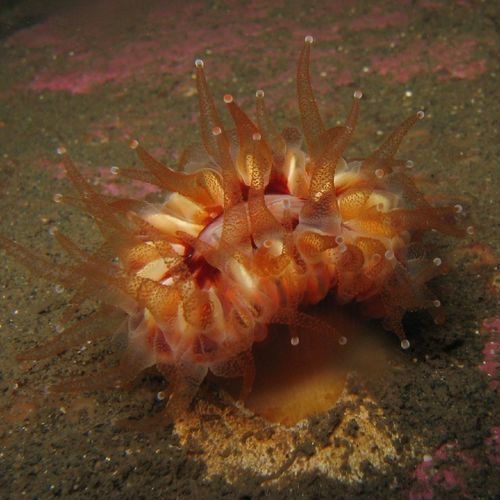
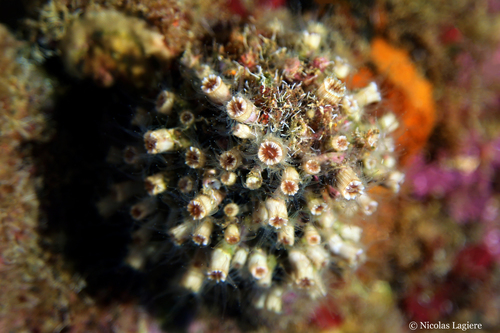
Polycyathus muellerae is a colonial species of coral with large polyps. Individual polyps are initially joined by an encrusting basal lamina. Over time, this basal lamina may wear away, allowing other organisms to settle and live between the polyps. This species grows by budding new polyps from the basal lamina, forming rather diffuse colonies that can reach around one metre in diameter. Each individual polyp sits inside a stony cup called a corallite, which measures approximately 6 mm (0.24 in) in diameter and 10 mm (0.4 in) in height. Corallites have up to four cycles of toothed stony ridges called septa, for a total of 48 septa. Both corallites and polyps are brown. The tentacles, which are 3 to 4 mm (0.12 to 0.16 in) long, have white granulations and white cylindrical tips. This species is native to the northeastern Atlantic Ocean, the North Sea, the English Channel and the Mediterranean Sea. It typically avoids direct sunlight, growing in caves and under overhangs at depths of 30 m (100 ft) or shallower. P. muellerae is a non-zooxanthellate coral; unlike most corals, it does not form a symbiotic relationship with microscopic dinoflagellates, and instead gets all of its nutrition from planktonic organisms caught by its polyps. Asexual reproduction via budding increases the size of the colony. Sexual reproduction has not been observed in this species, but its widespread distribution suggests that sexual reproduction is likely to occur. This coral is sometimes parasitized by the barnacle Megatrema anglicum. A study of organism communities living in caves in southern Italy found that algae were abundant in the brighter areas near cave entrances, while sponges were the dominant organisms in the deepest interior sections of the caves. In the intermediate zone between these two areas, corals including Polycyathus muellerae were found alongside hydroids, serpulid worms, bivalves, worm snails, bryozoans and sea squirts.