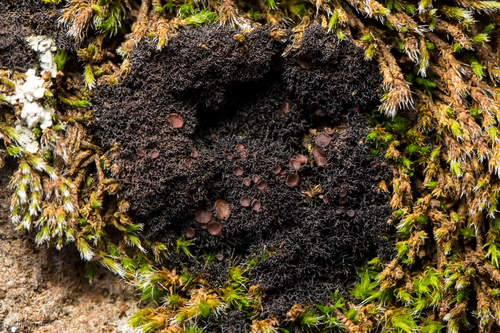
About Polychidium muscicola (Sw.) Gray
Description. Polychidium muscicola forms minute, shrub-like tufts made of slender filaments that branch almost dichotomously, and these weave into domed or straggling cushions. Each filament is round in cross-section and wrapped in a distinct cortex one to several cells thick, which encloses a central bundle of hyphae with rounded walls. The photosynthetic partner of this lichen is the cyanobacterium Nostoc, which gives the thallus the ability to fix atmospheric nitrogen. Each "woolly-bear" tuft is structured like a tiny brush: stout fungal hyphae run perpendicular to the branch axis, creating a stable core that holds chains of Nostoc that are either twisted or straight. The filament is wrapped in a distinctive brick-work cortex made of rounded fungal cells, which differs from the interlocking-puzzle cortex found in the related genus Leptogidium. Sexual fruiting bodies are mainly lateral apothecia, with brown discs that sit slightly sunken below a low rim. No true thalline margin surrounds these apothecia, but a proper exciple made of fungal tissue is present. Threads called paraphyses run through the hymenium; they are unbranched, divided into segments by cross-walls, and have tiny swollen capitate apices. Asci are broadly cylindrical, contain eight spores each, and their thickened apices show a blue K/I+ reaction. Ascospores are either one-celled or two-celled, colourless, and ellipsoidal to spindle-shaped, with either thin or relatively thick walls. Asexual reproduction happens in small, brown pycnidia that also develop on the sides of the filaments. These structures hold short conidiogenous cells that bud off rod-shaped (bacilliform) conidia. Thin-layer chromatography has not detected any secondary metabolites (lichen products) in the genus Polychidium. Habitat and distribution. The genus Polychidium has been recorded across regions ranging from tropical to subarctic. These lichens grow on moss-covered rocks and on the small twigs of trees.

