About Polycera quadrilineata (O.F.Müller, 1776)
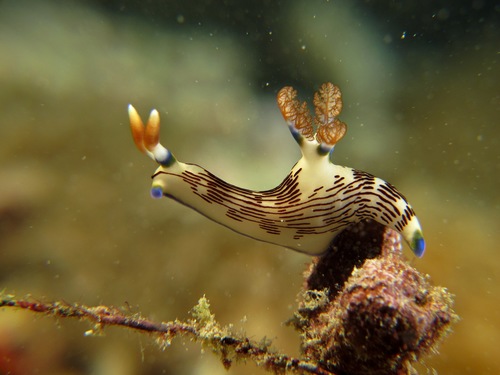
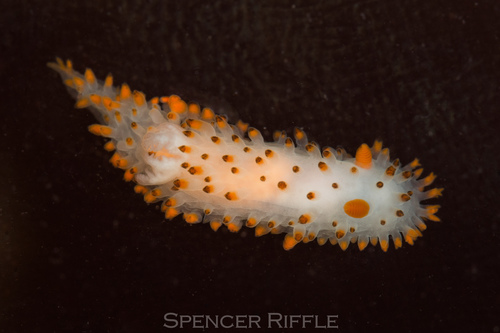
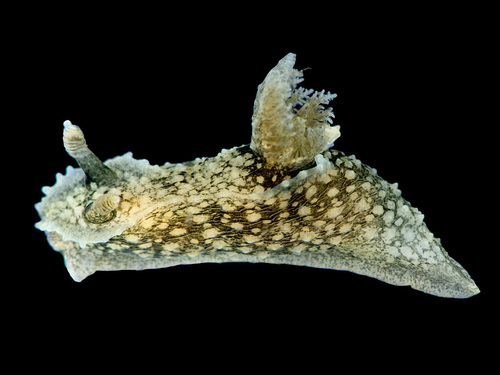
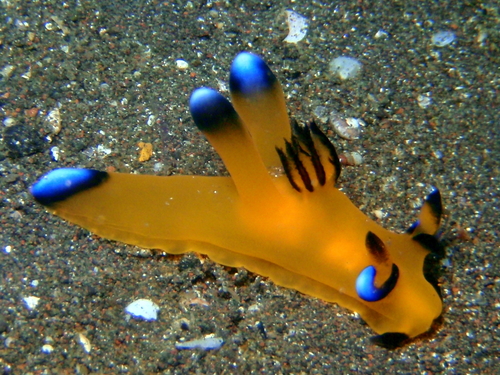
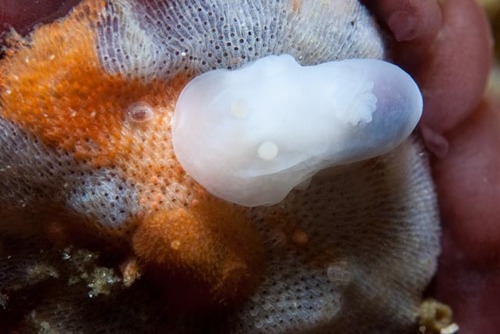
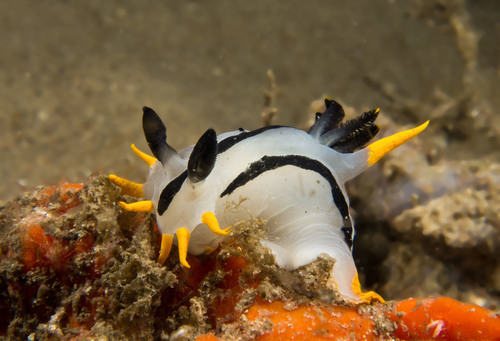
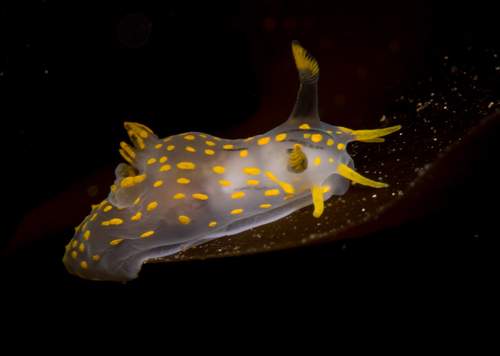
Polycera quadrilineata is a nudibranch with a smooth body and variable coloration. Its base body color is white or grey, and it typically has longitudinal black, yellow or orange stripes running along the notum, though these stripes can sometimes be absent. The head bears four yellow projections, and occasionally six. Its gills and rhinophores are translucent white, with yellow tips. Two processes sit alongside the gill cluster, and their glandular tips are pigmented orange or yellow, which matches the general orange or yellow body pigmentation of this species. Specimens found in South Africa have black gills and rhinophores, which may be marked with yellow spots, and a pair of yellow-tipped projections alongside the gills. This nudibranch can grow to a total length of 20 millimeters. It can be distinguished from the crowned nudibranch by the presence of raised yellow spots on its mid-dorsal region. This species was first described from Norway. In the northeast Atlantic, it is a common shallow-water species, distributed from Greenland to Norway, ranging south along European coasts into the Mediterranean Sea. It occurs from the intertidal zone down to a depth of 160 meters. It has also been reported off the South African coast, from the Atlantic coast of the Cape Peninsula to Algoa Bay. South African specimens differ from typical Polycera quadrilineata by having six papillae projecting from the frontal margin of the head instead of four, as well as differences in coloration. Studies conducted in 2014 and 2020 have demonstrated that these South African animals actually belong to an undescribed separate species. Polycera quadrilineata feeds mainly on the bryozoans Membranipora membranacea and Electra pilosa.