About Polycera capensis Quoy & Gaimard, 1824
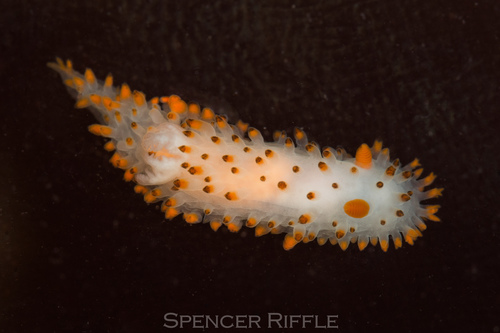
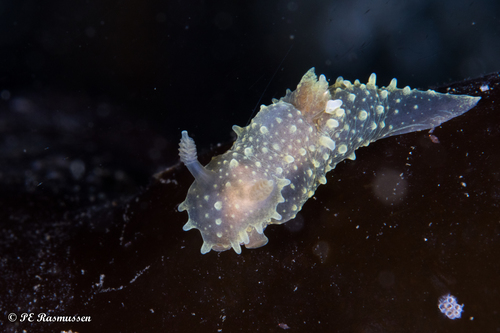
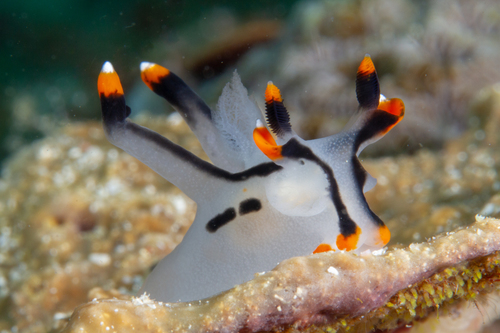
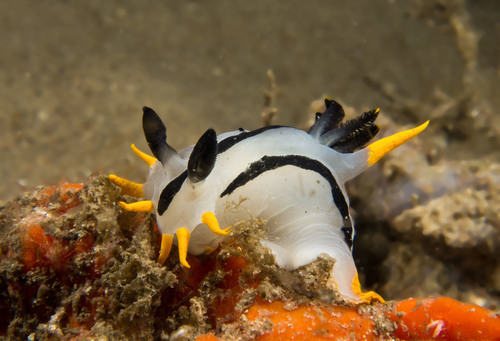
Polycera capensis, commonly known as the crowned nudibranch, is a variably colored nudibranch with a smooth body. Its base ground color is white or grey, and it usually has longitudinal black, yellow, or orange stripes along the notum, though these stripes can sometimes be absent. The head bears six yellow projections; the gills and rhinophores are black, and may have yellow spots. A pair of yellow projections sits alongside the gills. Adult specimens can reach a total length of 50 mm. A DNA sequencing study has found that two separate species were grouped together under the label P. capensis, with one of these being the Twin-crowned nudibranch originally described by Gosliner in 1987.
This species is native to southern Africa, where its range extends from Luderitz, Namibia, to Port Alfred, South Africa. It can be found from the intertidal zone down to a depth of 35 meters. P. capensis is also an invasive species in eastern Australia; it was first introduced near Sydney in the 1920s, most likely via vessel biofouling. Since its introduction, it has spread southward along Australia’s east coast, and is now established as far south as Tasmania.
In terms of ecology, the crowned nudibranch feeds on bryozoans that belong to the genus Bugula. It produces an egg ribbon that forms a wavy white collar.