About Polycauliona coralloides (Tuck.) Hue
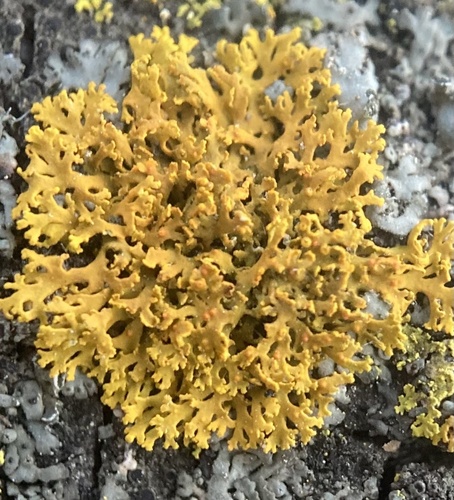
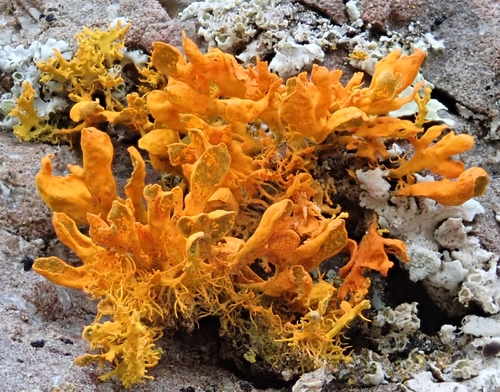
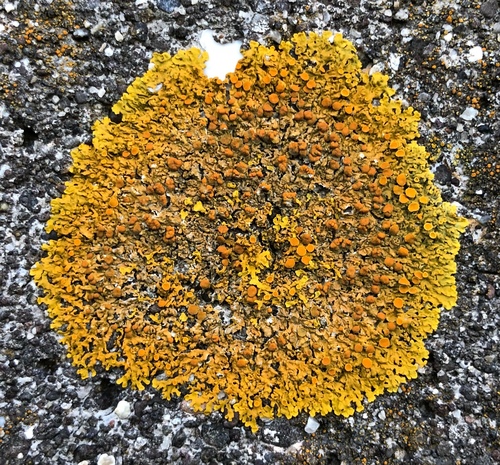
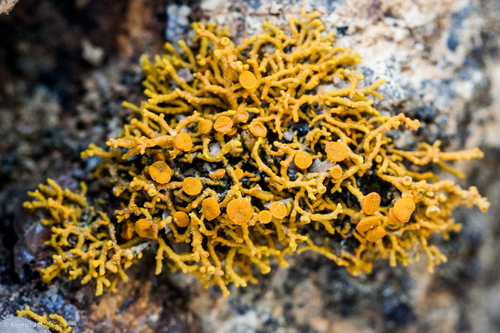
Polycauliona coralloides is a dwarf-fruticose lichen that forms dense to loose cushions up to 2 cm (13⁄16 in) in diameter and 8 mm (5⁄16 in) in height. Its branches are terete, more or less dichotomous, and can be erect, arched, or almost prostrate. The branches measure about 0.4 mm in diameter, with a round and bumpy texture. The thallus ranges in color from yellow to orange-yellow, and may have pseudocyphellae in small depressions. Initially, P. coralloides forms elongated thallus lobes that adhere closely to the substrate, but over time it develops into a distinctly subfruticose thallus. Apothecia are fairly common, zeorine, and can be found at the ends of branches or along their length. Their disc is slightly darker in color than the thallus. The spores are polaribilocular and ellipsoid, with a very thin septum. Chemically, this species has parietin as its major pigment, alongside small amounts of emodin, teloschistin, parietinic acid, and fallacinal. The thallus and apothecia react K+ (purple) in spot testing, while the medulla shows negative reactions to standard chemical spot tests. Polycauliona coralloides is a strictly littoral species, found near the seashore, growing predominantly on hard rocks, most often on vertical surfaces. It typically grows in the lower part of the supralittoral zone within a narrow vertical range. This species often grows closer to the shore than Caloplaca rosei and Caloplaca brattiae, and avoids sites exposed to bird manuring. As a littoral species, it is quite tolerant to sea salt. The distribution of P. coralloides extends from northern Baja California, Mexico, to northern Oregon. While it may possibly occur further south, it is unlikely to grow further north due to unsuitable habitats in that region. It has also been documented in Channel Islands National Park. Stigmidium hesperium is a lichenicolous fungus first described in 2009 that parasitises Polycauliona coralloides. Infection by this fungus causes erosion and bleaching of the lichen's thallus and apothecia.