About Polyboroides typus A.Smith, 1829
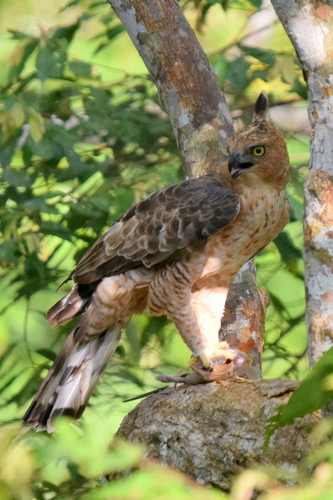
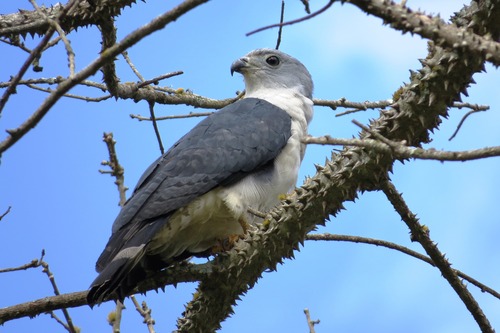
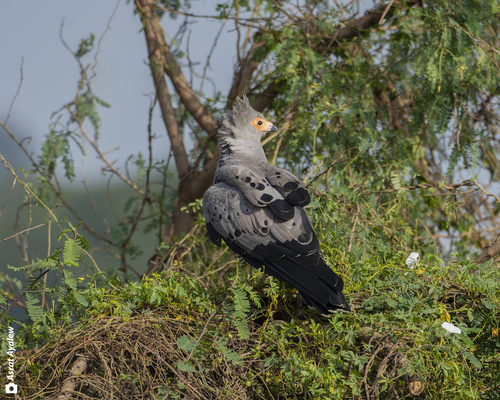
The African harrier-hawk, with the scientific name Polyboroides typus A.Smith, 1829, is a medium-sized raptor. Its upperparts, head, and breast are pale grey. The belly is white with fine dark barring. Its broad wings are pale grey, with a black trailing edge fringed by a narrow white line. The tail is black with a single broad white band. This species has a bare facial patch of variable colour, most often red or yellow. Males and females look similar, but young birds have pale brown plumage instead of grey, and dark brown plumage instead of black. An unusual characteristic of this species is its double-jointed ankles, which let it reach prey into holes and cracks that would otherwise be inaccessible. A similar leg structure and related behaviour are also seen in the Neotropical crane hawk and the extinct Australian Pengana, which is a case of convergent evolution. The call of the African harrier-hawk is a whistled sueee-sueee-sueee. African harrier-hawks are a common raptorial species found south of the Sahara. They are most common in the tropical regions of western Africa, and become less common in East and South Africa. This species is adaptable in its habitat preferences. In the Dzanga-Sangha Special Reserve in the Central African Republic, it occupies thick rainforest, forest edge, riparian areas, agricultural land, and human occupied areas. African harrier-hawks can live in both urban and rural human-occupied areas, and they are one of the most common raptorial species in traditional rural villages of eastern Guinea-Bissau. They have also been recorded breeding in palm trees located in cities and urban gardens.