About Polybius henslowii Leach, 1820
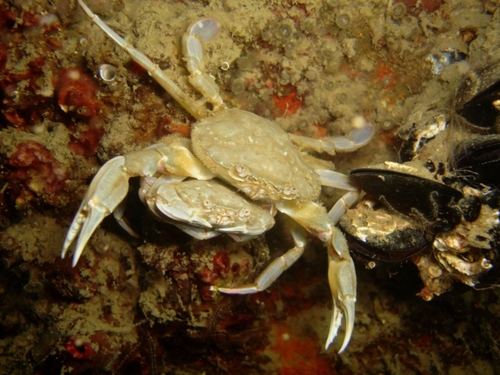
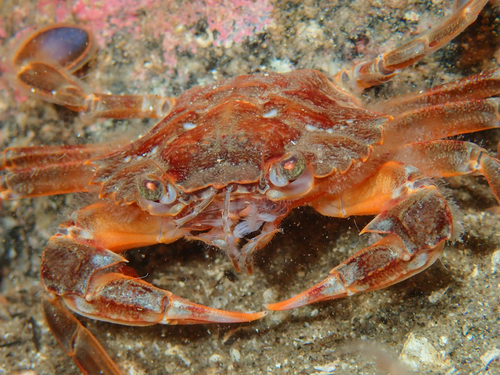
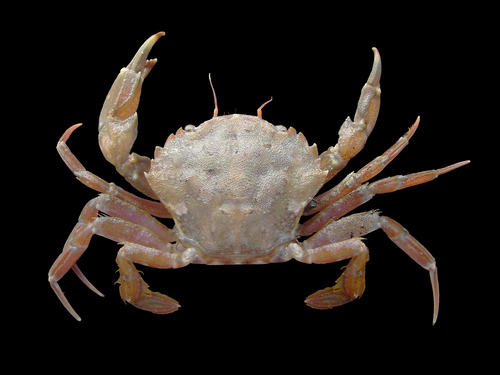
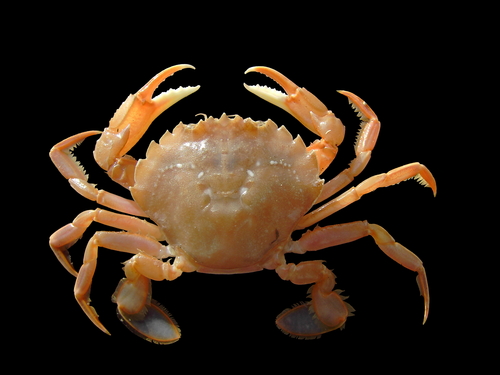
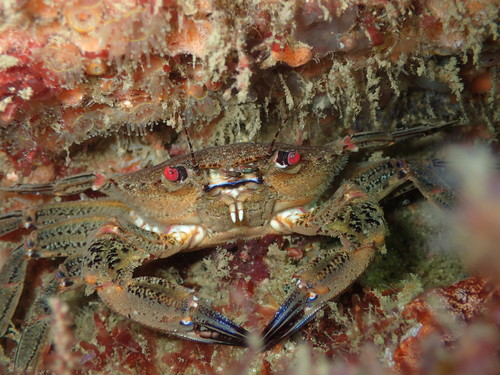
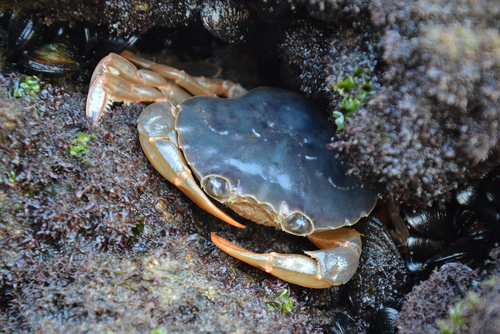
Polybius henslowii Leach, 1820 has an almost circular carapace, measuring 48 millimetres (1.9 in) wide and 40 mm (1.6 in) long. The first pair of its pereiopods (walking legs) bear claws, while the remaining four pairs are flattened with fringed edges. This trait differs from other members of the family Portunidae, in which only the last pair of legs is adapted for swimming. The upper surface of P. henslowii is red-brown, and its underside is paler. Polybius henslowii occurs in the northeast Atlantic Ocean from the British Isles to Morocco, and in the western Mediterranean Sea. Very large, abundant swarms of the species have been recorded along the coasts of Galicia, Spain, and off Portugal. Rare individual specimens have been caught in the North Sea east of Shetland, and in the Skagerrak. The species' range has expanded into the southern North Sea, a shift possibly caused by climate change. It lives on sandy or gravelly sediments at depths up to 500 metres (1,600 ft). Polybius henslowii is a strong, capable swimmer that can be found swimming near the ocean surface, where it feeds on a mixed diet of squid, fish, other crustaceans, including other members of its own species. P. henslowii has been observed forming pelagic swarms. These swarms are made up mostly of females, which rules out the idea that the aggregations form for mating, though they may be related to feeding. When the crabs swim inshore into coastal upwelling areas of Galicia (northwestern Spain), they rely more heavily on benthic prey such as polychaetes and detritus, and their diet is influenced by terrestrial organic matter carried from rivers. In northwestern Spain's Galicia, P. henslowii is an important food source for the yellow-legged gull, Larus michahellis. In summer, loggerhead turtles (Caretta caretta) off North Africa feed almost entirely on P. henslowii.