About Polyalthia longifolia (Sonn.) Thwaites
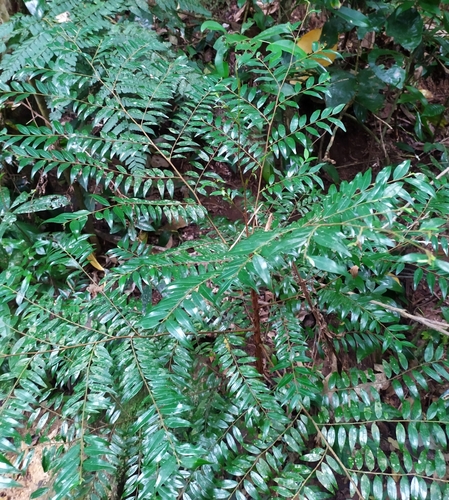
Monoon longifolium, commonly called false ashoka and widely known by its synonym Polyalthia longifolia (Sonn.) Thwaites, is a small Asian tree species in the Annonaceae family. It is native to southern India and Sri Lanka, and has been widely introduced to other regions across tropical Asia. This evergreen tree can grow to over 20 meters in height, and is commonly planted because it effectively reduces noise pollution. It has symmetrical pyramidal growth habit, with willowy, weeping, pendulous branches, and long narrow lanceolate leaves with undulate margins. Monoon longifolium is sometimes incorrectly identified as the ashoka tree (Saraca indica) because the two species look very similar. The cultivated columnar pendula form may appear to have no branches, but non-hybrid M. longifolium grown naturally, without having branches trimmed for decoration, develops into a normal large tree that provides ample shade. This species is native to India and Sri Lanka. It has been introduced to garden settings in many tropical countries worldwide; examples of its widespread introduced use include parts of Jakarta, Indonesia, and the Caribbean islands of Trinidad and Tobago. The leaves of this tree are used for ornamental decoration during festivals. Throughout India, the tree is a common focal point in garden landscaping. It can be pruned into a variety of shapes and kept at desired sizes. Historically, its flexible, straight, lightweight trunks were used to make masts for sailing ships, giving the tree the additional common name Mast Tree. Today, its wood is most often used to make small articles, including pencils, boxes, and matchsticks. Seed oil from M. longifolium has been confirmed to have antioxidant, anti-lipooxygenase, and antimicrobial activity against multiple microbe strains, along with other properties. A 2016 study by Bankole et al found that M. longifolium provides some control of chloroquine-resistant strains of Plasmodium berghei ANKA in mice, but it is not an effective treatment. Methanolic extracts of Monoon longifolium have yielded 20 known and two new organic compounds, some of which demonstrate cytotoxic properties. The fatty acid composition of the species' seeds has also been documented.