About Pollicipes polymerus Sowerby, 1833
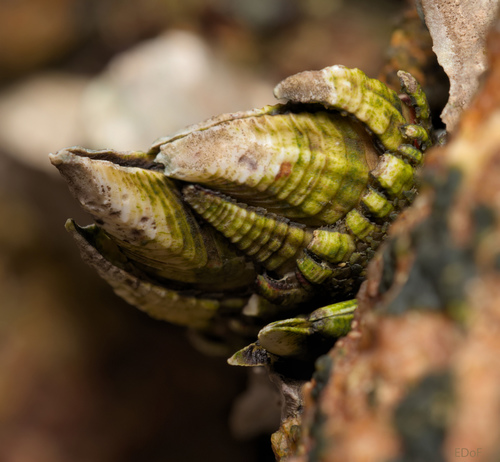
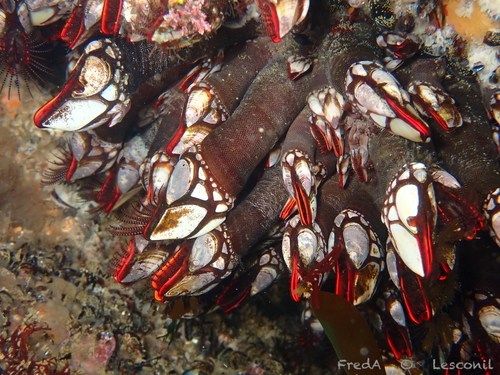
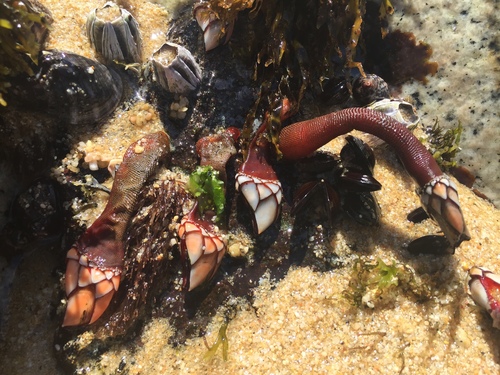
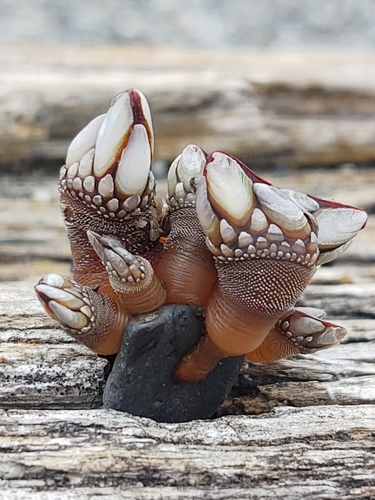
Pollicipes polymerus attaches to rocks or other hard objects via a strong, rubbery stalk called the peduncle. This stalk grows up to 10 centimetres (4 inches) long, has a muscular interior, and its leathery surface is covered in bands of minute spiny scales mounted on short stalks. At the end of the peduncle sits the capitulum, which grows up to 5 centimetres (2 inches) long and holds the rest of the barnacle’s body, including all limbs and other appendages except the first pair of antennae. The outer surface of the capitulum has five reinforcing calcareous plates that correspond to the protective plates of acorn barnacles. The largest of these plates is the carina, located on the morphological dorsal side of the capitulum, with a pair of smaller scuta and terga on either side below it. Additional calcification forms many small scales from other growth centres on the capitulum. The thoracic crustacean appendages of this species are modified into feather-like cirri, which extend through the aperture at the end of the capitulum to be used for feeding. Pollicipes polymerus is found in the northeastern Pacific Ocean, with a range extending from southern Alaska to Baja California. It inhabits rocky intertidal coasts, and favours exposed locations with heavy wave action. It typically grows in dense, closely packed groups and is often abundant in suitable habitat. This species is a hermaphrodite. Reproduction occurs during the summer, and an individual may produce several broods per year. Ovaries are located in the upper part of the peduncle, and release between 104,000 and 240,000 eggs at a time into the mantle cavity, where the eggs stick together to form egg masses. Numerous small testes lie alongside the gut. Sperm from these testes travels along an extensible penis into the mantle cavity of an adjacent individual for fertilisation. Self-fertilisation does not occur naturally, and any individual more than 20 centimetres (8 inches) away from its nearest neighbour is effectively unable to reproduce. Eggs are brooded for 3 to 4 weeks until they hatch into nauplius larvae, which are released into the sea to become planktonic and feed on phytoplankton. The larvae grow and moult 6 times over about 40 days before developing into non-feeding cyprid larvae. Cyprid larvae search for a suitable settlement site, then attach themselves permanently to the substrate by secreting a strong adhesive from glands on their antennules, before undergoing metamorphosis. Settlement is stimulated by the presence of other gooseneck barnacle peduncles, and cyprids may settle directly on existing peduncles. Pollicipes polymerus is an omnivore. It feeds by extending its cirri through the capitulum aperture and unfurling them. The posterior three pairs of cirri are biramous and form a net to trap food particles. They are held at an angle that lets them intercept moving water, and are periodically withdrawn back into the capitulum along with any trapped food. Particles are scraped off the net by the other three shorter pairs of cirri, which have overlapping bristles called setae. The particles are then transported to the mouth, where they are manipulated and sorted into edible and inedible items by the maxillae, mandibles, and palps. This sorting process may be aided by chemoreceptors located on the appendages and near the mouth. Examination of gut contents shows this species feeds on copepods, amphipods, other barnacle larvae, small clams, polychaete worms, hydrozoans, detritus, and algae. Predators of this gooseneck barnacle include the glaucous-winged gull (Larus glaucescens), the black oystercatcher (Haematopus bachmani), the ochre sea star (Pisaster ochraceus), and the six-rayed star (Leptasterias hexactis). A 1966 research study by Robert T. Paine in Makah Bay, Washington State demonstrated the importance of predators for maintaining biodiverse coastal communities. Paine excluded ochre sea stars from a seabed area dominated by gooseneck barnacles and California sea mussels (Mytilus californianus), and found that the number of associated invertebrate species dropped from fifteen to eight. This led Paine to propose the hypothesis that "Local species diversity is directly related to the efficiency with which predators prevent the monopolization of the major environmental requisites by one species". The populations of both gooseneck barnacles and sea mussels have a patchy distribution. To investigate this pattern, a 1994 study by Wootton excluded birds from an area containing both species on Tatoosh Island, Washington. In a carefully designed series of experiments, he recorded direct and indirect effects on the population numbers of gooseneck barnacles, sea mussels, acorn barnacles, starfish, and predatory whelks (Nucella spp.) in the study area. His results confirmed that bird predation plays an important role in shaping the population dynamics of gooseneck barnacles. Gooseneck barnacles compete with many other organisms for limited space in their rocky intertidal habitat, as part of a complex ecological struggle. The first organisms to colonize bare rock are usually annual algae, which are soon followed by perennial species including coralline algae. Gooseneck barnacles, sea mussels, and several species of acorn barnacles then colonize the area. Additional competition comes from sea palms, whose large holdfasts can smother or squeeze out mussels and barnacles. Sea palms may settle on mussels, and can be carried away during storms, pulling the attached mussels with them. Gooseneck barnacles can limit the colonization of new mussel recruits by feeding on mussel larvae. In areas where gooseneck barnacles become established, they can dominate the habitat until some individuals are swept away in storms, creating open space for other species. Over the long term, sea mussels usually become the dominant species, as their byssal threads can overgrow all other sessile organisms in the community.