About Pollicipes pollicipes (Gmelin, 1790), 2020
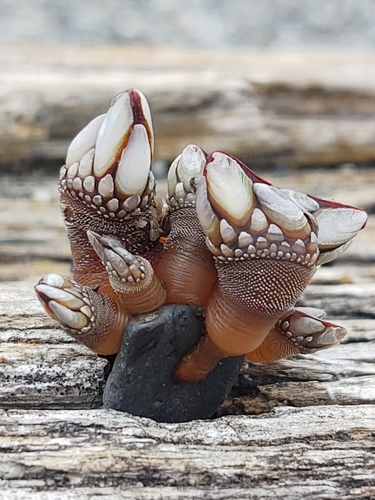
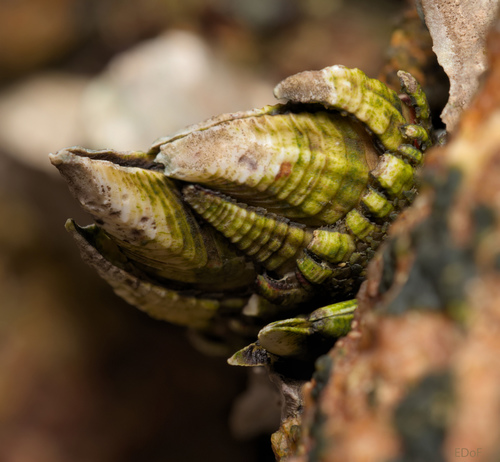
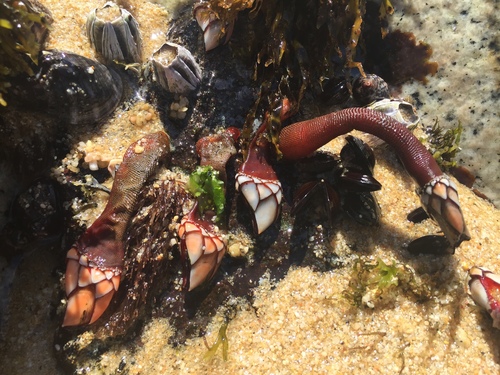
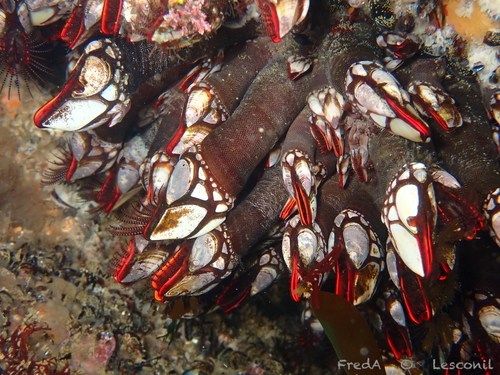
Pollicipes pollicipes (Gmelin, 1790), also known by the taxonomic synonym Pollicipes cornucopia, is a species of goose barnacle. It is commonly called the goose neck barnacle, goose barnacle, or leaf barnacle. It is closely related to Pollicipes polymerus, a species that shares these common names and is found on the Pacific coast of North America, as well as to Pollicipes elegans, a species native to the coast of Chile. This barnacle inhabits rocky shores in the northeast Atlantic Ocean, and is highly valued as a delicacy, particularly in the Iberian Peninsula. The core distribution of Pollicipes pollicipes ranges from 48°N to 28°N, along the coasts of France, Spain (including the Canary Islands), Portugal, and Morocco, extending south to Senegal. The outer edge of the species' range reaches as far north as Ireland, with isolated outlying populations on the south coast of England and possibly in southwestern Ireland, though there are no recent records of the species at these outlying sites. It is present but rare in the Mediterranean Sea. Outlying populations may not be self-sustaining, and are instead maintained by larval immigration from core self-sustaining populations. A geographically separated population located around the tropical Cape Verde Islands at roughly 16°N was described as a new separate species, Pollicipes caboverdensis, in 2010. Pollicipes pollicipes grows in groups on rocks, and also can be found on the hulls of shipwrecks and driftwood. It is a filter feeder that obtains food by collecting particles from water that passes over its extended cirri. Its cirri have a complex set of setae that allow the species to have a varied diet, including diatoms, detritus, large crustaceans, copepods, shrimp, and molluscs. The larvae go through seven free-swimming stages (six nauplii stages and one cypris stage) over a period of at least one month. After completing these stages, they settle and develop into sessile adult forms. Pollicipes pollicipes is harvested for food across most of its range, primarily to supply the Spanish market where it is marketed as percebe gallego, and can sell for as much as €90 per kilogram. Due to this harvest, the species' population is thought to be declining. Harvest of this species is done manually, and archaeological evidence shows that this species has been harvested by hand for over 10,000 years.