About Pollicipes elegans (Lesson, 1831)
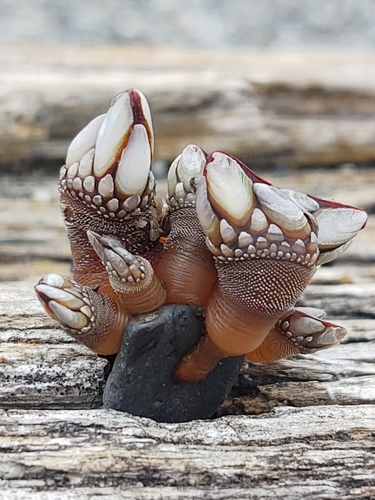
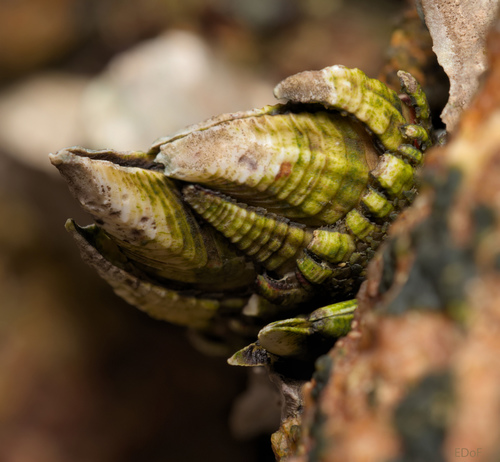
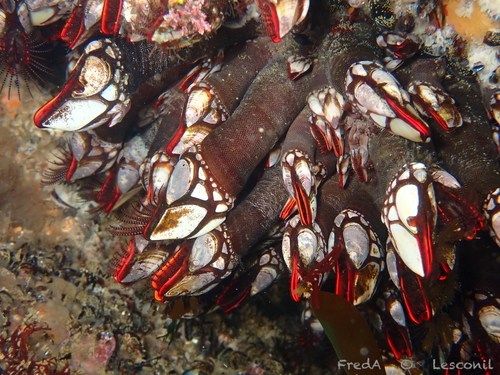
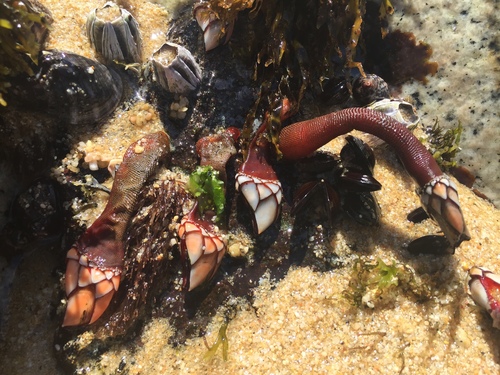
Pollicipes elegans is a stalked marine goose barnacle. It has a plated capitulum shaped like a goose head, which is made up of two hinged shells that open for feeding. The capitulum is held up by a scaled peduncle that attaches the organism to hard substrate. Both the capitulum and stalk are red-orange. This red-orange color matches the coloration of P. polymerus, but differs from the eastern Atlantic species Pollicipes pollicipes, which is consistently colored gray and white. The scales of P. elegans are long and narrow. This species occurs in the eastern tropical zone of the Pacific Ocean, where it grows scattered across rocky intertidal zones. Habitats are generally similar across the entire genus Pollicipes: clustered mounds of goose barnacles protrude from various substrates, and these clusters often attach to inverted rocks that hang above tidal pools. The rock inversion lets the shell opening extend out into the water surface below. P. elegans can be found along Pacific coastlines from northern Mexico all the way south to the northern tip of Chile. However, stretches of Central American coastline have higher air and water temperatures that stop P. elegans populations from dispersing across these areas. Historical climate barriers like this, such as extreme cold or extreme heat, split the original tropical population of the species. Despite the high temperatures in this region, there are still stable populations of P. elegans in Costa Rica and El Salvador. The species also shares overlapping habitats with P. polymerus across southern California. Unlike many barnacle-type organisms, P. elegans does not commonly grow on ship hulls or floating docks. Like its close relatives, P. elegans is a hermaphroditic organism. Even though it is hermaphroditic, the high density of its colonies leads to high rates of polyandry for the species; some spawning groups can include up to five participating males. This polyandry functions either to compensate for smaller population sizes, or to guarantee successful fertilization of future offspring.