About Pollanisus viridipulverulenta (Guérin-Méneville, 1839)
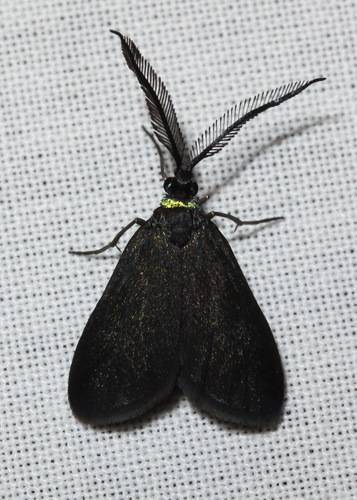
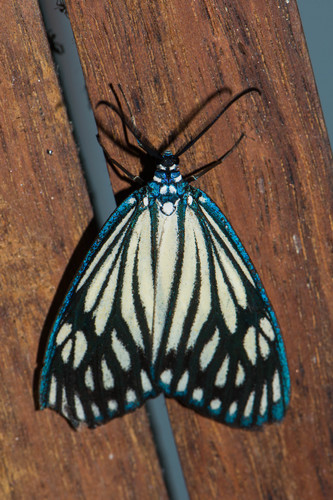
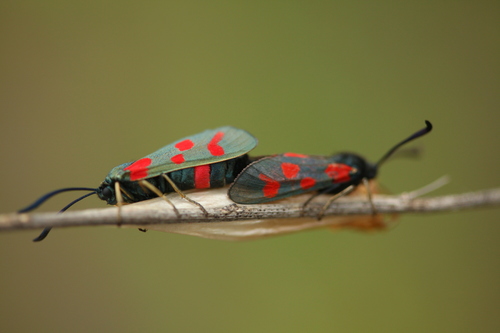
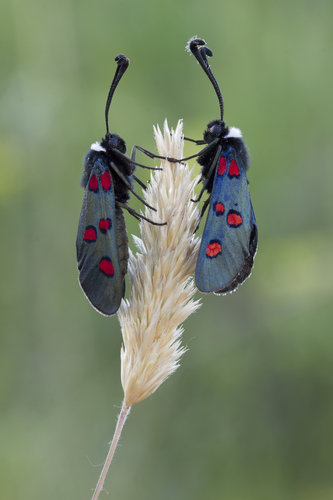
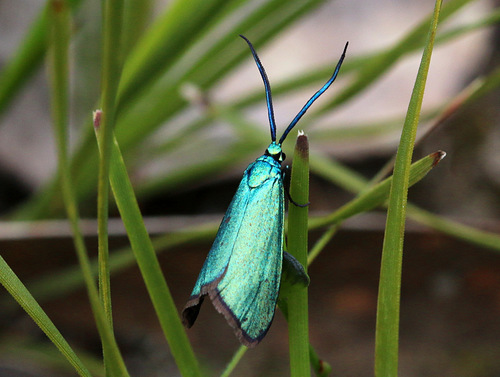
The scientific name of this species is Pollanisus viridipulverulenta (Guérin-Méneville, 1839). Adult moths have metallic blue-green heads, thoraxes, and forewings, while their hindwings are grey. The total wingspan of the adult moth is roughly 30 mm. For male individuals, forewings measure between 11 and 13 mm in length; for females, forewings measure between 8 and 9 mm. Females have a yellow tuft of hair at the tip of their abdomen. This species looks similar to other adult moths in the genus Pollanisus, specifically P. apicalis and P. subdolosa. P. apicalis is generally smaller than Pollanisus viridipulverulenta, and has narrower wings. P. subdolosa can be distinguished from Pollanisus viridipulverulenta by the bronze "collar" it has behind its head. The larvae of this species are brown, and have clumps of short hair. In the species' life cycle, adult moths are active in flight from August and early September to January. In Queensland and South Australia, they begin flying in August and early September, while flying activity extends through to January in Tasmania. Female moths use hairs from their abdominal tufts to camouflage their eggs. Larvae feed on a variety of Hibbertia species, including Hibbertia obtusifolia, Hibbertia stricta, and Hibbertia sericea. They pupate inside cocoons, located either amongst the foliage or in leaf litter at the base of their host plants.