About Polistes instabilis de Saussure, 1853
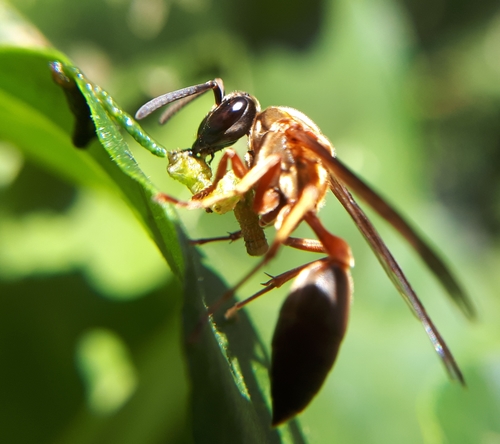
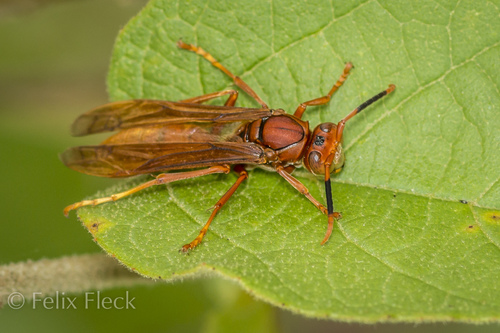
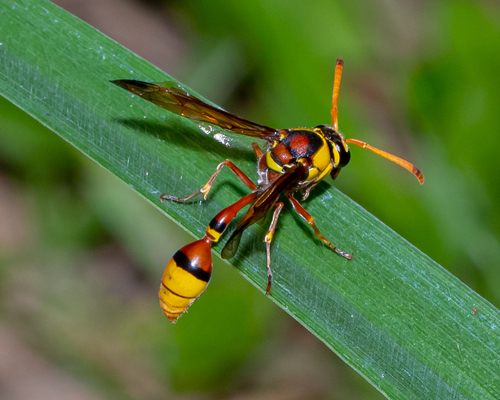
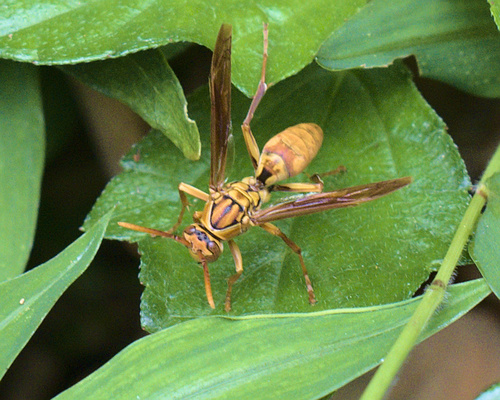
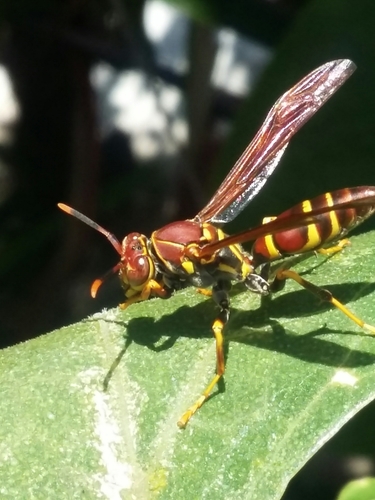
Description and identification: Polistes wasps, including Polistes instabilis, are large social wasps marked with yellow, brown, and reddish coloring. Their total body length ranges from 0.51 to 0.98 inches (13 to 25 mm), with wings measuring approximately 0.55 inches (14 mm) that fold lengthwise against the body. Male Polistes are generally smaller than females; males also have yellow faces and curled antenna tips, while females have straight antenna tips and more dark markings on their faces. Their nests are built from paper created by chewing plant fibers, attached to a surface via a stalk. Unlike nests of some other wasp species, the nest cells of P. instabilis are left uncovered. Distribution and habitat: Polistes instabilis occurs in tropical and subtropical regions of Central and South America, specifically in Mexico, Belize, Guatemala, Honduras, Nicaragua, and Costa Rica. Populations in Costa Rica typically inhabit lowland dry forest areas. After the rainy season ends in December, individual wasps migrate to higher elevations to overwinter. On Mexico’s Yucatán Peninsula, this species and Polistes stabilinus (which shares a similar morphology, has overlapping ranges across Mexico and Central America, and may be a synonym of P. instabilis) share multiple common names: Xananch'ak in Poqomam Mayan, meaning "red mosquito"; Nichak in Yucatec Mayan, meaning "red nose"; and Avispa papelera in Spanish, meaning "paper wasp". In Yucatán Peninsula’s subtropical forests, these wasps can be seen during the rainy season, most often between August and September. They are sometimes also called Xanabchak in Yucatec Maya, meaning either "red shoes" or "lightning shoes". This alternative name likely arises from similar pronunciation between Poqomam Mayan and Yucatec Mayan, paired with the shared geographic range of these wasps.