About Polistes exclamans Viereck, 1906
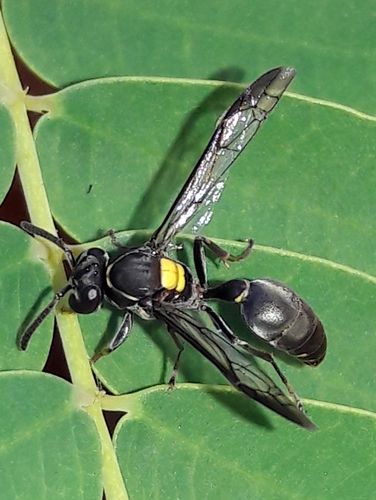
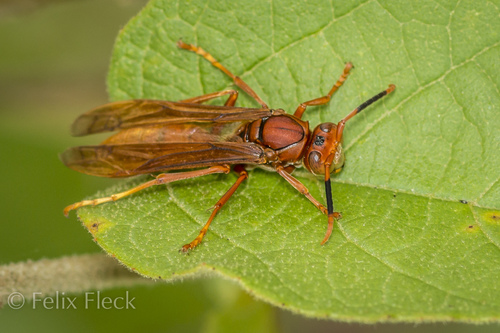
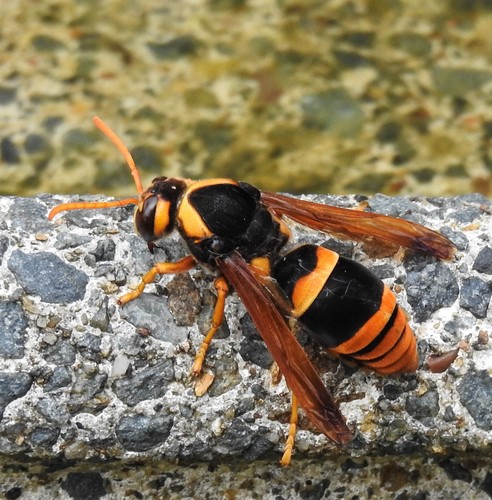
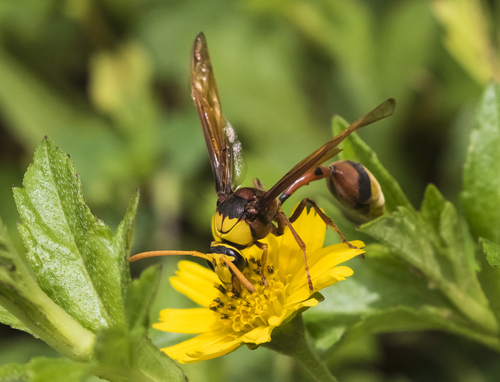
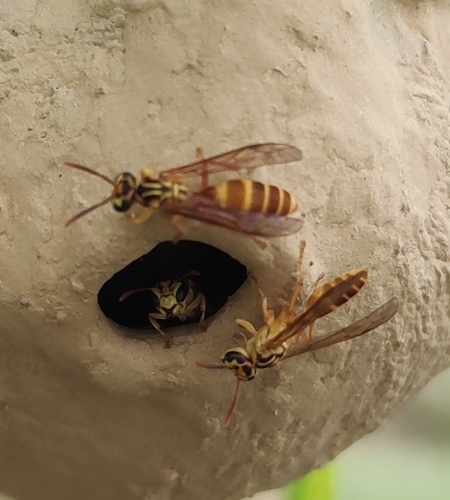
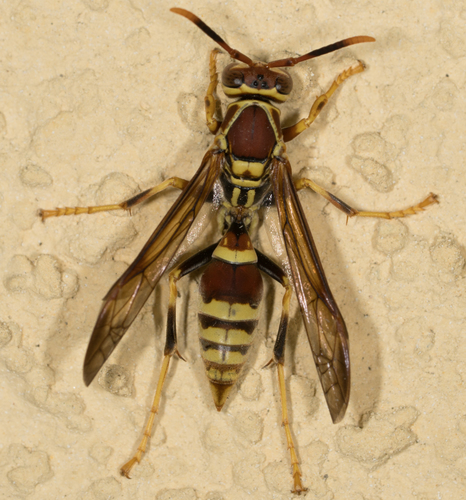
There are two forms of Polistes exclamans (paper wasp) in the United States: the typical form and the variable form. The typical form is native to the southeastern United States, occurring in North Carolina, South Carolina, Georgia, Alabama, Florida, Texas, Louisiana, Oklahoma, Arkansas, Kansas, Colorado, and Arizona. While the color of the typical form can vary, it almost always has some yellow markings: yellow markings on the propodeum and mesonotum, where the propodeum normally has four yellow stripes and the mesonotum has yellow lines. It may also have yellow markings on its head. Unlike the coloration of many other wasp species, its wings are not yellow or yellow-tinged; they are infuscate and purple. The typical form is often confused with Polistes fuscatus, Polistes crinitus, and Polistes minor. The variable form of P. exclamans is red-brown overall. The middle of the flagellum, the base of the abdominal segments, the outer side of the mid and hind tibiae, and the wings are all infuscate or black. Instead of yellow markings, the variable form has pale ivory-white markings spread across its body. All P. exclamans have antennae banded with red, black, and yellow, while most paper wasp species only have a single uniform antennae color. For adult females, fore wing length ranges from 13.0 to 16.5 mm (0.51–0.65 in), and for adult males, fore wing length ranges from 12.0 to 15.0 mm (0.47–0.59 in). The extent of ferruginous, rust-colored, markings on P. exclamans is variable. No distinguishing structural features separate workers and queens of this species, but males are easily identified by their bulging eyes, subquadrate clypeus, and slender antennae. Males of P. exclamans also have more variation in external morphology than females, a trait thought to be linked to male hemizygosity, as females are homozygous. P. exclamans lives in a hierarchical social structure with one primary queen that lays eggs. However, all females in the colony share the same external morphology and all are physiologically capable of taking over egg laying if the original queen dies or migrates away. Because queens have identical morphology to other worker females, how the queen role is assigned and what makes a queen unique remains an open question. Studies have found that queens and males of P. exclamans have higher levels of glucose, fructose, and trehalose than workers, which gives them higher cryoprotectant levels. This species uses these sugars as cryoprotectants, which work by increasing solute concentration in cells, leading to higher survival in cold weather. In 15-day tests at 5 °C (41 °F), queens had a 76% survival rate compared to just 17% for workers. Queens also have a 0.5 mm thick layer of fat surrounding their bodies, which lets them survive longer into winter and may extend their mating season. Queens appear to be the only members of the species capable of diapause. The overall distribution of P. exclamans extends across the United States, ranging from New Jersey south to Florida, from Florida west to Texas, and further west to Nebraska, Colorado, Arizona, and California. It has also been recorded in Mexico, the Bahamas, and Ontario, Canada. As a vespid wasp, P. exclamans typically builds nests out of paper, with a single layer of cells forming open combs. While nest size varies, the maximum recorded size is around 500 cells. Unlike many other vespid wasp nests, P. exclamans nests do not have an outer paper envelope. As noted by Strassmann and Orgren, nests are approximately circular, and have a single off-center pedicel, the basal attachment stalk, usually located toward the top of the nest. The oldest cells are those closest to the pedicle. This species is particularly good at colonizing new sites, because founding queens often disperse into new territories. P. exclamans nests are very commonly found near man-made structures, and the wasp readily builds nests in and around these structures. Out of six studied wasp species, P. exclamans was the only one that regularly occupied artificial nesting sites. It prefers well-lit, open locations. Polistes wasps like P. exclamans build nests from wood fiber collected from posts and plant stems, which they shape into a paper-like comb of hexagonal cells. Nests face downward and are held in place by a single attaching stalk. P. exclamans has also been observed occupying artificial researcher-placed nests made of bundled straw. Throughout the 1950s and 1960s, P. exclamans extended its native range into the midwestern United States. Between 1958 and 1967, new state records for the species were documented in Illinois, Indiana, Kentucky, Maryland, Missouri, New Jersey, New Mexico, Tennessee, and Virginia. The behavioral drivers behind this range expansion are tied to the species' exceptional ability to colonize new sites and its solitary nest founding behavior. This capacity is supported by the natural tendency of P. exclamans foundresses to disperse and move into newly available nesting sites. In contrast, wasp species with social founding queens reproduce close to their original location, and do not extend their ranges nearly as far.