About Polistes dominula (Christ, 1791)
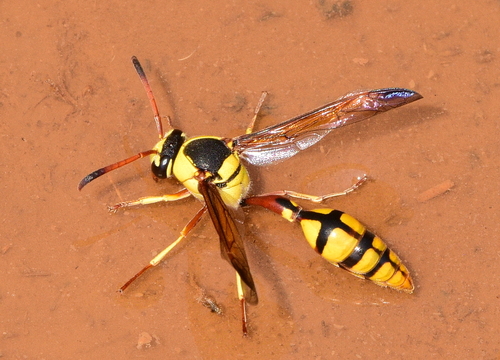
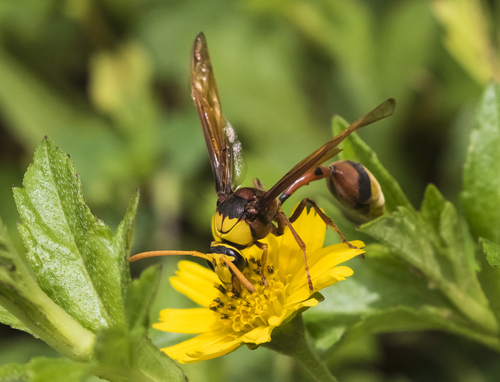
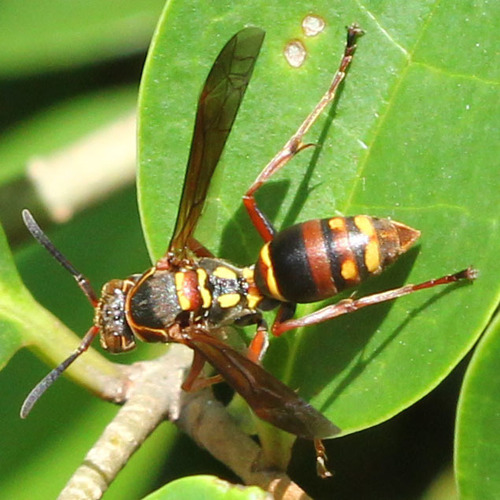
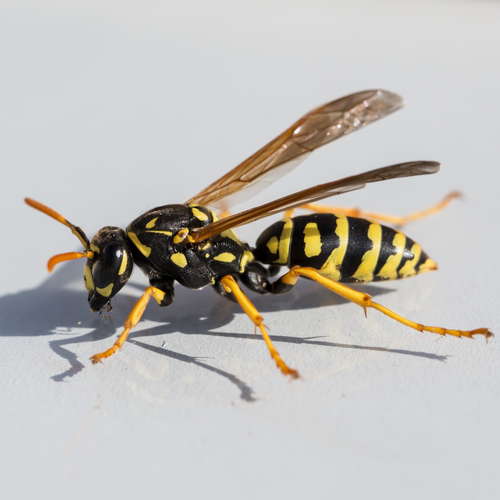
There is very little size variation between individual Polistes dominula wasps. Male wing lengths range from 9.5 to 13.0 millimeters (3⁄8 to 1⁄2 inch), while female wing lengths range from 8.5 to 12.0 millimeters (5⁄16 to 1⁄2 inch). The entire body is patterned yellow and black, similar in appearance to Vespula germanica, a common and defensive wasp found in P. dominula’s native range. Female P. dominula have black mandibles that sometimes feature a yellow spot. They also have a black subantennal mark that only rarely has a pair of small yellow spots. The female vertex sometimes has a pair of small yellow spots behind the hind ocelli, and females have yellow, comma-shaped spots on the scutum. The native range of P. dominula covers most of southern Europe, North Africa, and temperate parts of Asia extending east as far as China. This species has also been introduced to New Zealand, Australia, South Africa, and both North and South America. Since the mid-1980s, P. dominula populations have expanded into cooler regions, particularly toward northern Europe. Researchers speculate that global warming has raised temperatures in these areas, allowing the species to spread into what were originally too-cool habitats. The first recorded North American occurrence of P. dominula was reported in Massachusetts in the late 1970s, and by 1995 the species had been documented across the entire northeastern United States. It is likely that the species is also present in additional U.S. states but has not yet been formally reported there. The detailed mechanisms of P. dominula dispersal are still unknown, but it is thought that individual wasps including foundresses may hide in transportable items like shipping crates, trailers, and boats, or in other human-made structures used during international trade between countries. P. dominula generally inhabits temperate, terrestrial biomes including chaparral, forest, and grassland. The species also commonly colonizes areas near human settlements, because man-made structures provide effective shelter and are often located close to food resources. Overwintering founding queens (called foundresses) spend approximately one month in spring building a nest and provisioning for their offspring; the first of these offspring become daughter workers that help grow the colony. Colonies are started by one or more foundresses in spring. When multiple foundresses start a colony together, the foundress that lays the most eggs becomes the dominant queen, while the remaining foundresses act as subordinates that perform work to support the colony. Males are produced later in the colony cycle. Once males begin to appear, a small number of daughter wasps may mate and leave the nest to become foundresses the following season. Unlike what is observed in many other Polistes species, the shift from producing workers to producing future foundresses (called gynes) is not completely abrupt. Males can be easily distinguished from females by their curled antennae and lack of a stinger. Colonies disperse in late summer, and at this point only males and future foundresses are produced instead of workers. Individual wasps often cluster together in groups called hibernacula to overwinter, and hibernation usually does not occur at the former nest site. Social hierarchies within the colony influence the longevity of individual P. dominula: queens live longer than both males and workers, because workers protect queens from predators. The queen begins laying eggs in late March or early April, right after the founding phase of the newly built nest. After colonies disperse in late summer, only males and future foundresses are produced instead of workers. Even though wasps cluster together to overwinter, most nonreproductive males and nonreproductive females do not survive the winter, as their lifespans are shorter than one year (around 11 months) and they survive best in warm temperatures. Only queens can survive the winter through hibernation. Female P. dominula can distinguish between nestmates and non-nestmates. Groups of three wasps show more discrimination and aggression toward non-nestmates than groups of two wasps. In trios, aggression is higher because nest defense can be shared with other nestmates, while a single wasp experiences a higher cost of aggression than the benefit gained from defense. All insect body surfaces are coated with cuticular hydrocarbons (CHC) that provide waterproofing. In P. dominula, these chemicals also enable recognition between individuals, kin, and nestmates. Adult P. dominula coat their nests with the same cuticular hydrocarbons found on their own bodies, allowing the wasps to recognize their nest. Analysis of CHC profile differences between dominant and subordinate females shows that while differences are not clear during the early stages of nest founding, they become prominent once workers emerge. Dominant female CHC profiles have a higher proportion of distinctive long-chain unsaturated alkenes compared to the profiles of subordinates. When the original queen is removed, the replacement queen’s CHC profile becomes similar to that of the original queen. When researchers tested whether CHC profiles signal fertility or dominance, they concluded the chemicals act as a signal of dominance: subordinates with developed ovaries still had CHC profiles that differed from those of dominant females. Salivary proteins collected from P. dominula nests have been cloned for use as a waterproof coating in the manufacturing of biodegradable drones. The lightweight material used for the unmanned aerial vehicle’s body is made of fungal mycelium covered with bacterial cellulose sheets. This cellulose is then waterproofed with a coating of the cloned protein, which is one of the components of the saliva the wasps use to waterproof their own paper nests.