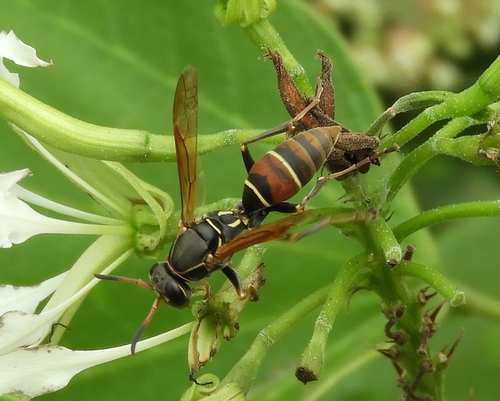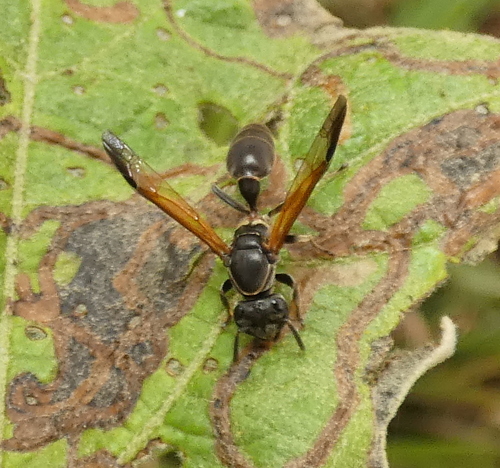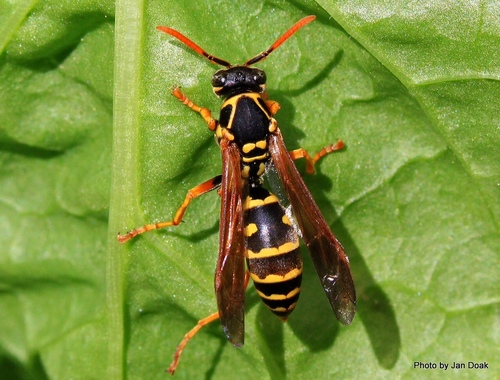
About Polistes chinensis (Fabricius, 1793)
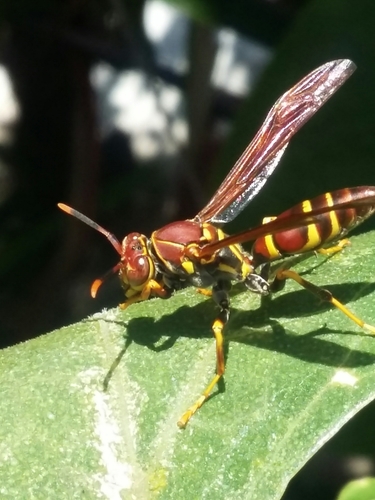
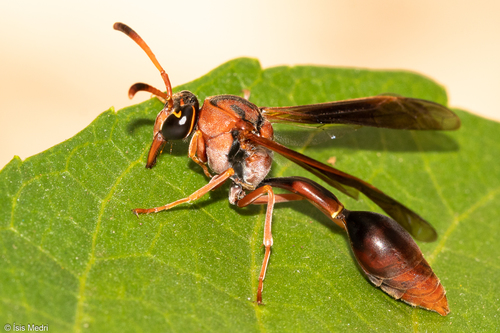
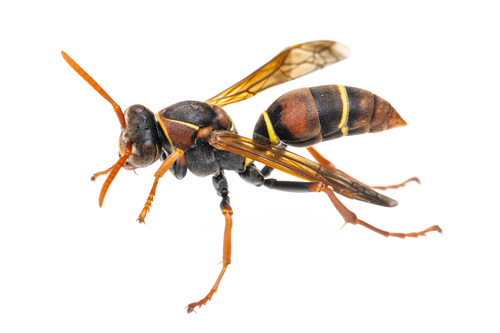
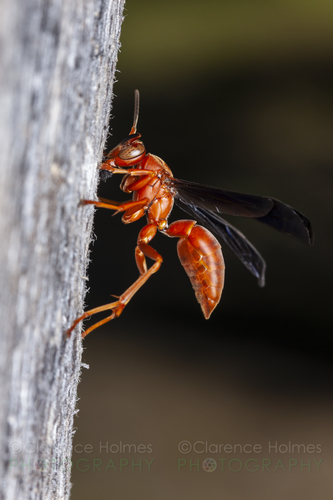
Description and identification: The Asian paper wasp (Polistes chinensis) has a slender body that measures 13 to 25 mm (0.51 to 0.98 in) in length. Its body is reddish brown or black, with yellow rings and reddish areas on the abdomen. The wings are reddish or amber brown, and the species has long legs that hang down when it is in flight. The general structure of the spermatheca is similar in both reproductive and non-reproductive individuals, and the spermathecal gland attaches to the central region of the spermatheca.
Distribution and habitat: The Asian paper wasp frequently builds nests on man-made structures such as houses and buildings. It also constructs nests on trees or bushes, most often on branches, and sometimes on leaves. P. chinensis prefers to colonize urban habitats, though nests have also been found near forest clearings. The wasps sometimes build nests in dense shrubs, which makes the nests difficult to locate. Large populations typically develop in warm, lowland areas with open habitat, including shrublands, swamps and meadows. This paper wasp is native to East Asia, and has been recorded in China, Japan, Korea and Mongolia. The subspecies P. chinensis antennalis is invasive in New Zealand; it is widespread in the North Island and the northern South Island, and competes with native species for food. It has since also been recorded on Norfolk Island and in New South Wales. At least two independent invasion events, linked to Kanto and Kyushu, Japan, have been proposed as the source of New Zealand's Asian paper wasp populations. The Asian paper wasp was first recorded in New Zealand in 1979, in Kohimarama and the Whangaparāoa Peninsula. It remained limited to these areas of Auckland until 1984, when it began to spread to inner city areas and western suburbs.
Reproductive conflict: Workers of this species police each other's eggs. 88.5% of a queen's eggs survive until hatching, compared to just 1.4% of workers' eggs. Worker reproduction is common in queen-right colonies (colonies where the queen is still alive). Both the queen and workers replace workers' eggs. This reproductive conflict in Polistes chinensis was studied alongside Polistes snelleni for comparison; in P. snelleni, queens have full monopoly over egg production. Queens contributed 2.4 times more to egg replacement than workers. Workers sequentially carry out oophagy and oviposition in the same cells. In a colony containing between 100 and 500 wasps, the ratio of worker-produced eggs to queen-laid eggs is 3 or 4 to one.