About Polistes carnifex (Fabricius, 1775)
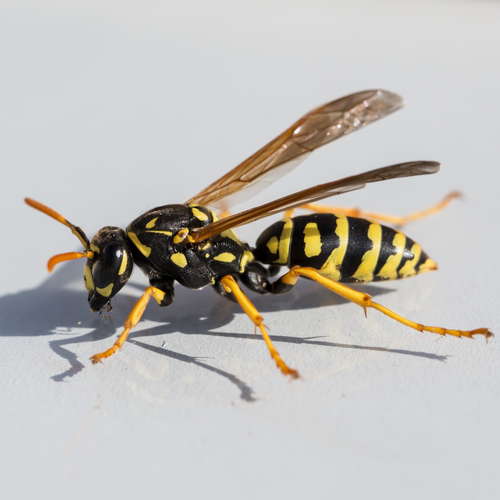
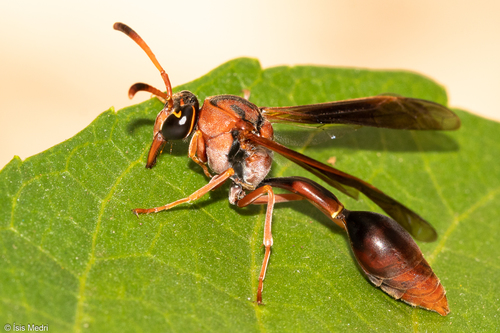
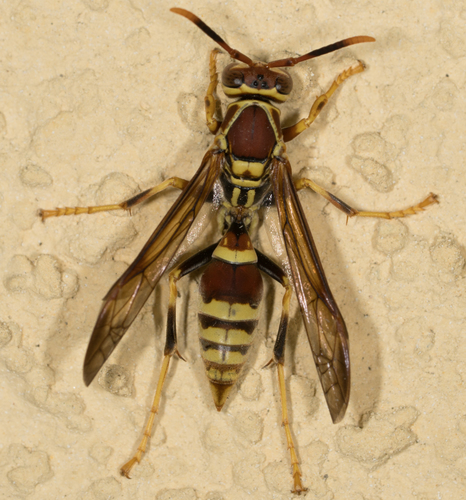
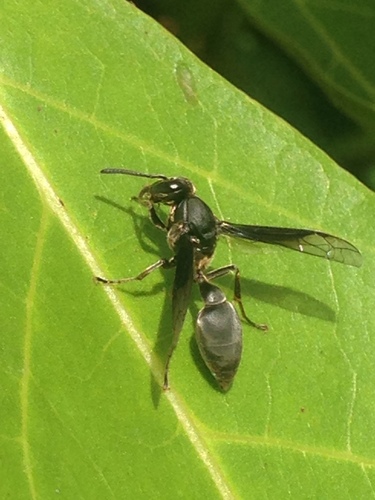
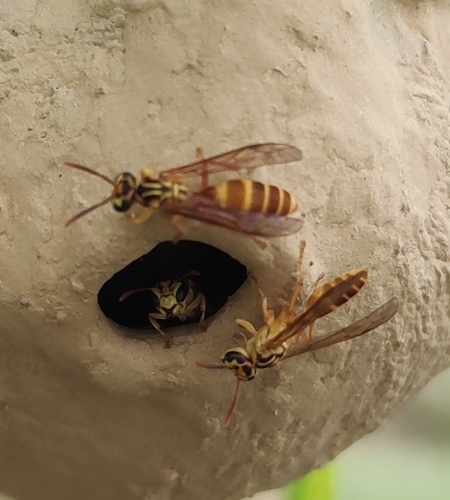
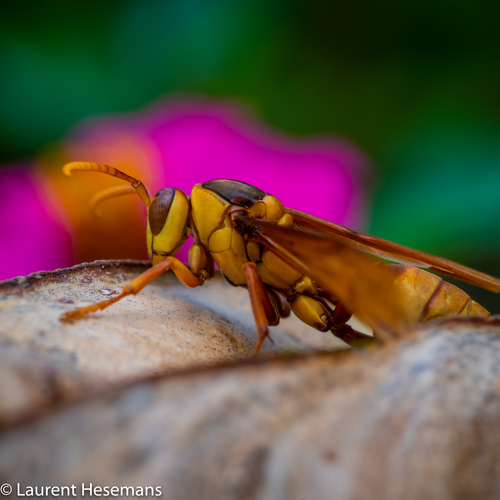
Polistes carnifex (Fabricius, 1775) is the largest Neotropical wasp in the genus Polistes, with a body length that typically measures 24 to 27 millimeters, and can reach a maximum of 33 millimeters. Despite its large size, this species is relatively non-aggressive. Its body is primarily yellow with some brown stripes that are partially blackish. The antennae are yellow with a darkened base; the head is yellow, with a black crown that ends in reddish-brown stripes. The maxillae are reddish-brown and outlined in black. The thorax is yellow with a black dorsal section that features four dark reddish-brown spots, and the pronotum is completely or almost completely yellow. The abdomen is yellow, with the second abdominal segment (tergite) darkened at its base. The wings are reddish-brown or yellowish reddish-brown, and the feet are dark-colored.
This species belongs to a group of Polistes species that can be separated from other Polistes species by the absence of a groove called the epicnemial sulcus on the underside of the head. Within this group, P. carnifex can be distinguished by its wide cheek plates, a very compact first tergite that is dorsally convex and vertically elevated relative to the constriction where the abdomen connects to the thorax, eyes that do not touch the clypeus, consistently large body size where all individuals are longer than 20 millimeters, and a first gastral sternite that is longer than it is broad. According to Ducke, the nests of P. carnifex are characteristic for the species (at least among the Polistes species whose nests were known during his time) due to their relatively long, strong central petiole.
The subspecies Polistes carnifex rufipennis differs from the nominate subspecies by having a tan brown, almost chestnut body and wings, as originally described by Latreille. In this subspecies, the antennae and the last quarter of the tarsi are more yellowish. Yellow markings appear above the jaws, on the posterior back edge of the first thoracic segment, at the very end of the thorax, beyond the second scutellum, on the posterior edges of the first three abdominal segments (tergites and sternites), and across the entire following abdominal segment. On the front abdominal segments, this yellow forms bands, while it forms two large connected patches that extend laterally to the far end of the thorax. Parts of the inferior and anterior sides, the outline of the scutellum, and the square segment above the scutellum that Latreille called the "second scutellum" are the same yellowish color, but more faint. The abdomen and wings are glossy, and the average body length of this subspecies is 26 millimeters.
Polistes carnifex is native to Central and South America, with a range that extends from Arizona and southern Texas in the United States south to Misiones Province in northern Argentina. In 1907, Ducke reported that the species occurred in the Greater Antilles, and in 1936 Bequaert claimed the species was not present in the United States or the Greater Antilles. Bequaert was proven incorrect in 1940, when the first United States specimen was collected in Arizona by John J. duBois; this record was first published in 1955. Confirmed localities include the Brazilian states of Rio de Janeiro, Pará, and Paraná; the Mexican states of Baja California, Guerrero, Jalisco, Morelos, Nayarit, Oaxaca, Sinaloa, Sonora, Veracruz, and Yucatan, as well as Mexico City; and the Paraguayan departments of Alto Paraná, Canindeyú, Paraguarí, and San Pedro. Both Bequaert noted that the species is not common anywhere, and Ducke added that it is infrequently seen in Pará, Brazil.
This species is found in coastal, humid, open areas such as evergreen tropical forests. In tropical regions including Paraguay, Brazil, and Argentina, it also occurs in extensive wooded habitats that do not receive heavy rainfall. In a 1972 study of six P. carnifex nests, not all nests contained a female with well-developed ovaries.