About Polistes canadensis (Linnaeus, 1758)
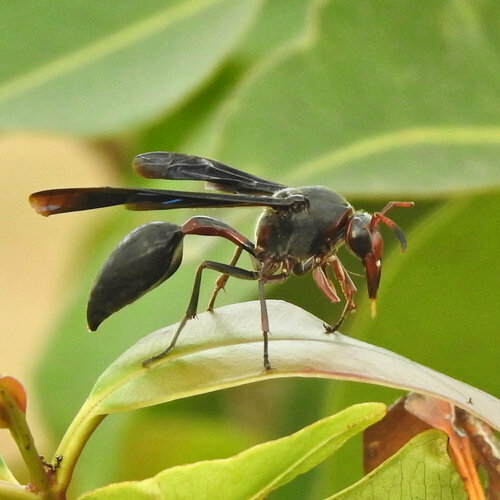
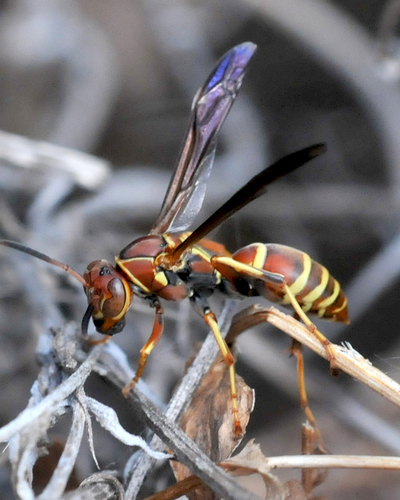
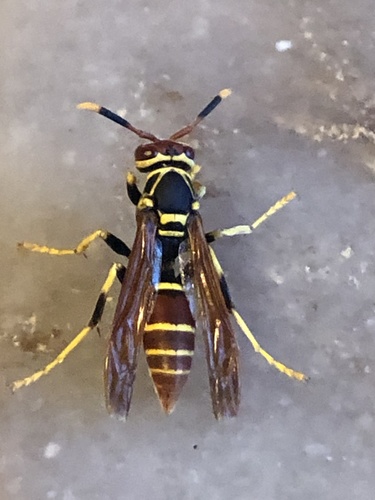
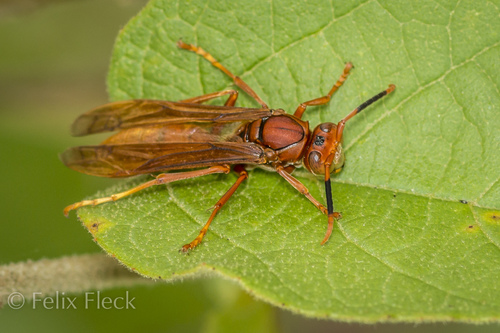
Both male and female Polistes canadensis have a uniformly light to dark mahogany-brown body; sometimes their head and thorax are a lighter shade. Some individuals also have a yellow apical margin on the first tergum. Their wings are purplish black, and the veins and stigma are either black or reddish brown. Polistes canadensis is a large-bodied wasp, with a wing length that ranges from 17.0 to 24.5 mm. Like other paper wasps, this species builds nests from plant fibers including dry grass and dead wood, which are mixed with the wasp's saliva to create water-resistant papery material. These nests do not have an outer covering envelope, and contain hexagonal cells where eggs are laid and larvae develop. Growing Polistes canadensis colonies often split into multiple combs, with an average of 30.8 cells per comb. A large, mature but still growing colony may have over 800 cells spread across more than 30 combs. Combs built on vertical surfaces like walls and tree trunks, and on sloping surfaces like tree limbs, hang with the petiole at the upper end. Colonies on tree trunks typically add secondary combs above or below the first comb, forming a linear arrangement. In contrast, nests on horizontal surfaces away from edges, such as ceilings, have eccentric petioles, with secondary combs arranged around the central primary comb in a semicircular perimeter. No comb has more than one petiole. Petioles average 9.9 mm in length. When combs reach their final size, adult wasps can usually step directly from one comb to an adjacent one; the average distance between the petioles of nearby combs is 2.9 cm. Although this is uncommon, adjacent combs sometimes fuse together if they come into contact. Polistes canadensis is widely distributed across most of the Neotropical region, ranging from Arizona in North America to Argentina in South America. Recorded locations include, but are not limited to, Mexico, Guatemala, Honduras, Colombia, Ecuador, Venezuela, British Guiana, Trinidad, Brazil, Peru, Bolivia and Paraguay. Nests of this species are often found on human-made structures such as buildings, in open habitats on tree trunks and large tree limbs, and in sheltered sites including caves, sheds, and under peeling bark.