About Polistes biglumis (Linnaeus, 1758)
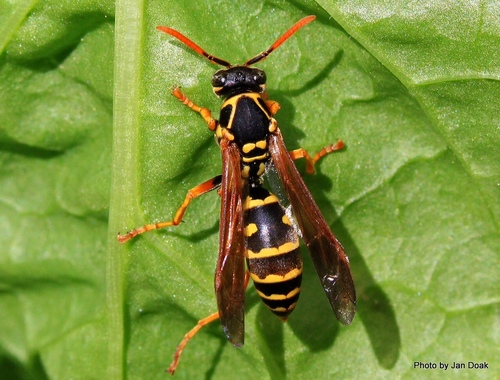
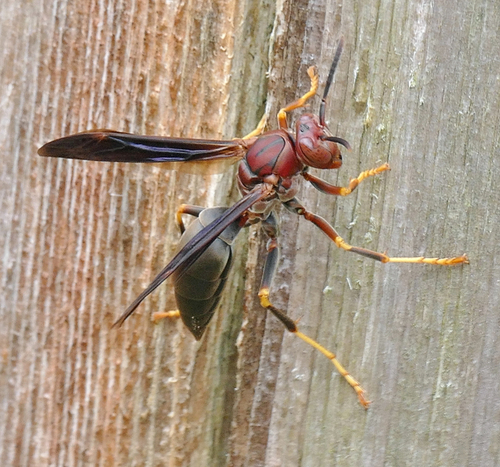
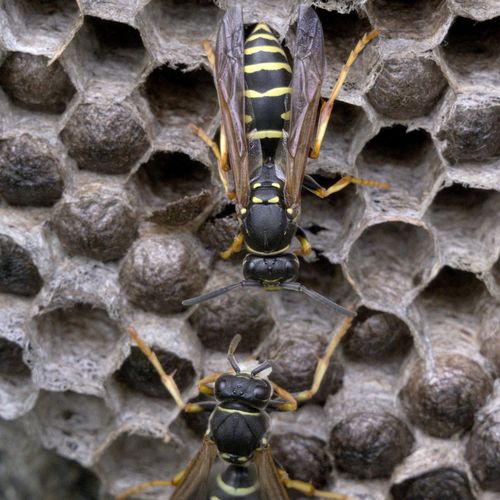
Polistes biglumis (Linnaeus, 1758) reaches different maximum body lengths across castes and sexes: queens grow up to 16 mm (0.63 in), workers up to 14 mm (0.55 in), and males up to 15 mm (0.59 in). This is a larger paper wasp species than most of its close relatives in the genus Polistes. It also has darker overall coloration than many other paper wasps, and both sexes have a completely black petiole. Females have entirely black abdomens, with yellow spots appearing only very rarely. In contrast, males have abdomens that are mostly yellow. Adult wasps can be told apart from immature wasps by their solid dark coloration and ability to fly, while young wasps have paler striping and cannot fly. Workers and queens have no obvious morphological differences, but they can be distinguished by the amount of fat layers in their bodies and by their foraging behavior. Queens have more abundant fat layers, and are far less likely to join in foraging for the nest. The color of the fat layers also differs between workers and queens: workers have yellow fat layers, while queens have milky-colored fat layers. Nests of P. biglumis are circular or elliptical in shape, and hang vertically from a single stalk called a pedicel. Most of the nest construction is done by the founding queen during the egg and larval production stages. Peripheral cells of the nest are usually not occupied. Compared to nests of other Polistes wasp species, P. biglumis nests are more commonly built closer to the ground, as the ground provides thermal inertia and shelter from strong winds. Nest material plays a key role in nestmate recognition: epicuticular hydrocarbons are deposited on the nest surface, and these chemicals form the system that individual wasps use to tell nestmates apart from other wasps. This species lives mainly in mountainous areas of Southern Europe, most notably in Italy and France. Its range includes both the cooler climate of the Alps and the warmer climate of the Apennines; neither of these climates is temperate, making P. biglumis unusual among Polistes species. Montgenèvre, a commune in the French Cottian Alps, has been widely used as a study site to research this wasp's behavior in its natural habitat. The species' range also extends into Uzbekistan, Sweden, Germany, and Austria. A small number of ecologists have applied the name P. biglumis to a wasp species found on Hokkaido, Japan, but the Japanese population is actually an undescribed species more closely related to Polistes nimpha than to the primarily European P. biglumis covered here. This undescribed Japanese wasp has been studied closely alongside Polistes snelleni, another common Japanese paper wasp. P. biglumis typically builds its nests on rock faces in mountain meadows, or in alpine areas dominated by Pinus sylvestris and Larix decidua. Colonies of this species are both small and uncommon, because its annual colony cycle is shortened to just four months. On average, a single colony contains around 30 individual wasps.