About Polistes annularis (Linnaeus, 1763)
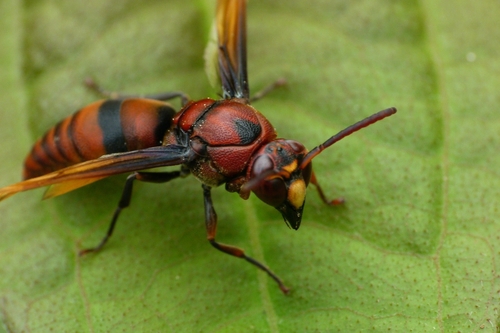
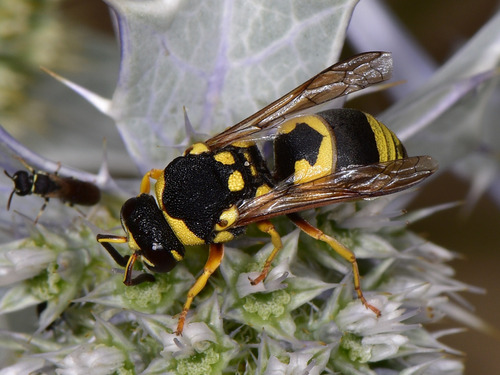
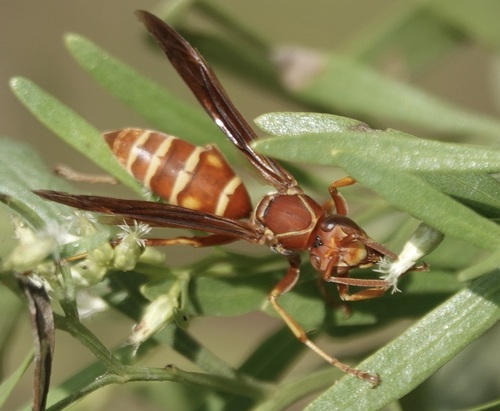
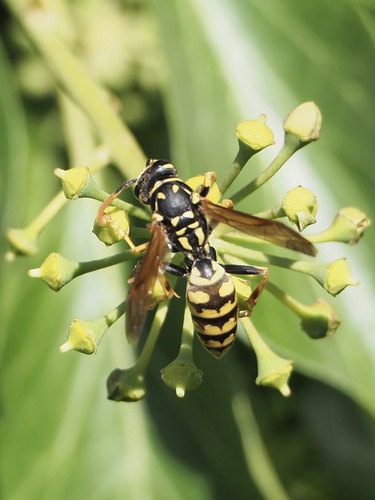
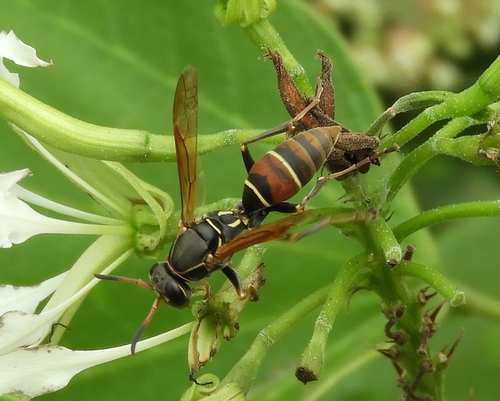
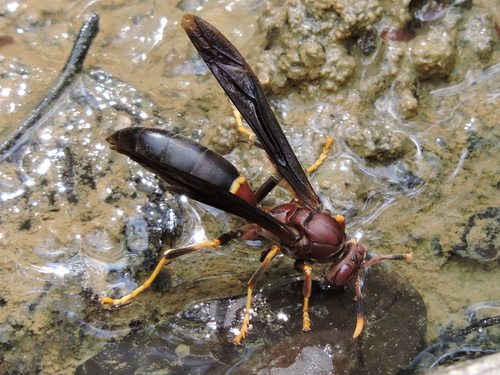
Polistes annularis (Linnaeus, 1763) is a member of the Polistes subgenus Aphanilopterus. This species has a narrow first metasomal segment and bright orange antennal segments. Within its range in the eastern United States, these shared traits also appear in its close relatives P. exclamans and P. bahamensis. The typical coloration of P. annularis includes a rust-red (ferruginous) head and thorax, and a mostly black abdomen with a single prominent yellow ring at the end of the first segment. There is consistent geographic color variation between northern and southern populations. In northern populations, the thorax has rust-red markings on a mostly black background, while in southern populations the thorax is mostly rust-red with black markings. Leg color also varies between black and ferruginous. For size, female forewings measure 18.5–23.5 mm (0.73–0.93 in) long, and male forewings measure 17.5–19.5 mm (0.69–0.77 in) long. P. annularis can be distinguished from darker P. bahamensis individuals (whose overlapping range with P. annularis only extends from Florida to Louisiana and North Carolina) by its lack of yellow markings on the mesopleuron, less developed yellow markings on the mesosoma, and no additional apical yellow bands on the tergum. Similarly colored species from the subgenus Fuscopolistes, including P. metricus and darker forms of P. fuscatus, can be easily separated by their lack of contrasting orange antennal tips and wider first metasomal segment. Unlike many other North American Polistes species, P. annularis and P. erythrocephalus unusually do not have sexual dimorphism in coloration. In these two species, males do not have extensive yellow face markings, and both males and females have red faces. Because of this, sex identification relies entirely on structural differences. Females have 12 antennal segments and 6 abdominal segments, while males have 13 antennal segments and 7 abdominal segments. Within the Polistes genus, the lateral mandibular groove is smaller than it is in other genera of social wasps. This groove connects to the mandibular gland and its sac-like reservoir that produces saliva. P. annularis larvae have labial glands that produce silk. P. annularis is distributed across the eastern United States, ranging from New York to Florida, and west to a line running from South Dakota to Texas. This range closely matches that of P. metricus, and the two species are Müllerian mimics. P. annularis builds individual nests on tree and shrub branches, as well as in sheltered areas of some buildings. It is also known to group nests into large shared colonies called aggregations. These aggregations are usually built on the underside of overhangs that block sunlight for most of the day, such as rocky cliffs, and are located very near bodies of water, most commonly riversides. The availability of these overhangs limits how many nests the species can build. P. annularis nests differ noticeably from those of other Polistes genus species. They are much larger, holding around 500 cells, and are wide rather than the slender, elongated nests built by some other Polistes species. Like other paper wasps, P. annularis constructs paper nests with cells left exposed to the outside environment.